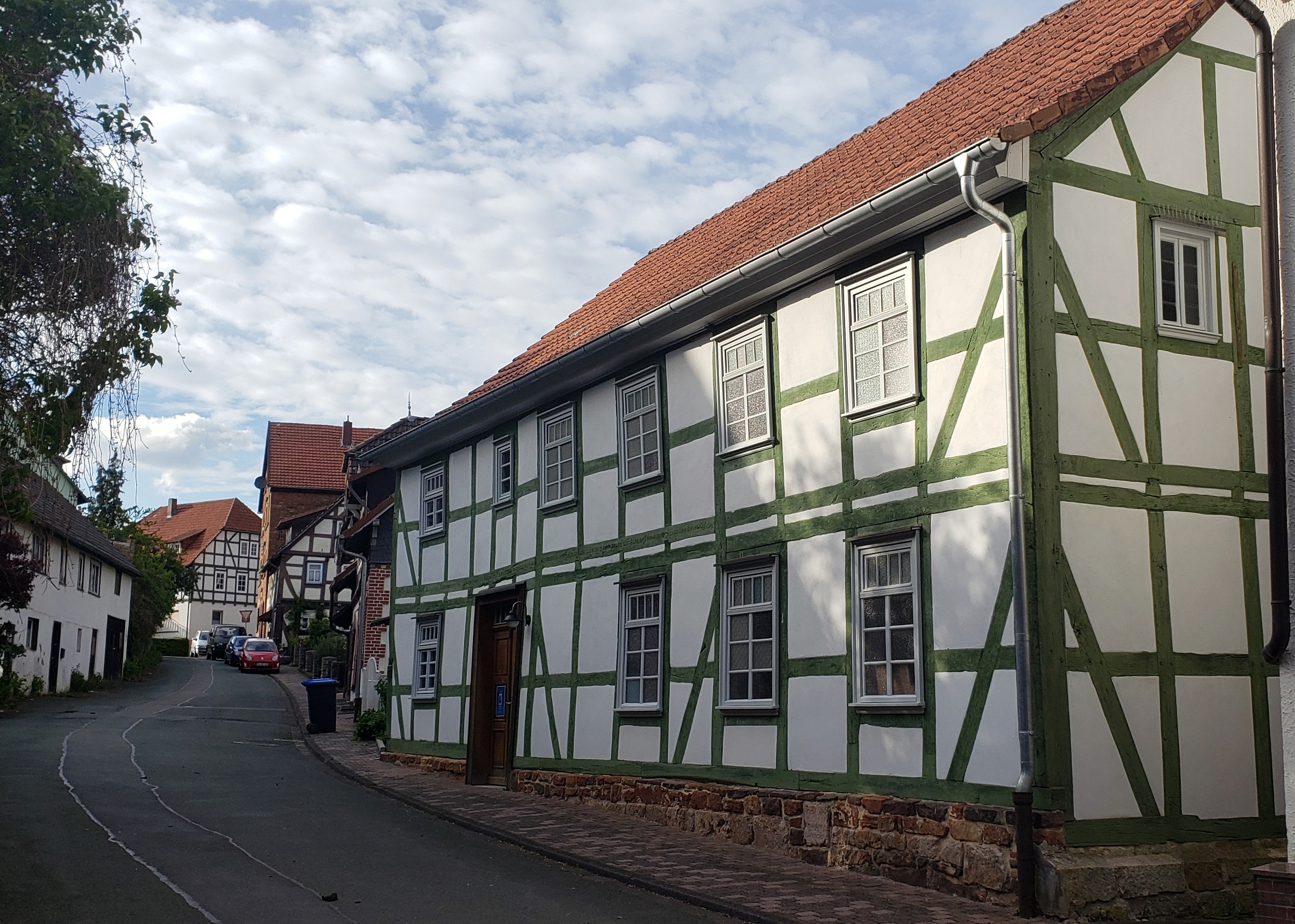
Moritz Moses Rothschild was born in Vöhl 28 August 1833, and was the last child born to Ascher Rothschild and his first wife Sprinza Sternberg. Moritz would not have remembered his mother, because she died on 5 September 1833, when Moritz was just 8 days old. Her death necessitated Ascher find appropriate care for his younger children, and turned guardianship of them over to his nephew Ruben Rothschild, who was married to Sprinza’s sister, Helene Sternberg.
What must his childhood have been like, I wonder, living with his uncle/cousin and aunt. What was his relationship with Ascher like? Did Ascher rejoice in the birth of a son, or blame Moritz for the loss of his beloved Sprinza? I don’t know. I would like to think Asher and Moritz had a good relationship, but it’s more than likely Moritz had a better father/child relationship with Ruben than with Ascher.
Most of the information about Moritz comes from his biography at the Synagogue Vöhl website. I’m just getting started, and already I’ve found something that caught my eye. In 1853, he received a certificate of residency for an indefinite period for the city of Hanau. Hanau? His sister-in-law Kathinka Luja is from Hanau. And just like that, my perception of how Adolph met Kathinka has shifted. What if Adolph went to Hanau to visit his little brother, instead of on family business, and that’s when he wandered into Frau Luja’s tobacconist shop? Honestly, that makes a lot more sense to me. Ok, let’s get back to Moritz. Adolph already had 3 posts, for heaven’s sake, he doesn’t need to hijack his brother’s!
1853 was the year he turned 20, the age young men were required to register with the military. The note for him regarding this says he’s wealthy, doesn’t represent himself. Which means he’s well-enough off to pay someone to take his place.
Moritz’ information in the civic records actually begins in 1848, when he was just 15. He, along with 21 members of the Jewish Community from Vöhl, and 34 from the surrounding region, was taxed 10 guilders. The only real explanation for someone so young to be taxed is because he comes from such a wealthy family.
On 22 October 1852, Moritz and his brother Selig received a certificate of residence for Darmstadt, good for 1 year.
In 1855, in addition to receiving a certificate of residence for an indeterminate duration for the electorate of Hesse, he was the administrator of the estate of Wittmer, a Christian, in Schafhof near Ziegenhain. Why would a Jew be the administrator of the estate of a Christian? Especially one located about 150 kilometers from Vöhl? The answer is… I don’t know. I’ll be sure to share if I ever figure it out.
On 13 January 1859, Moritz’ father, Ascher Rothschild, passed away. Perhaps this was the turning point in Moritz’ life, perhaps it was receiving an inheritance from the estate. Whatever it was that brought him back from his wanderings, Moritz spent the rest of his life in Vöhl. In fact, he’s the only one of his siblings to do so. All the rest moved away, some to Mainz, some to New York or St. Louis. While I’m grateful my gg-grandfather Adolph chose to come to America, there’s something sad in thinking this Rothschild family had been here for so long, and by the late 1800s, most of them had left Vöhl.
He liked dogs, and had a license for one in Vöhl throughout his life. He’s mentioned often in the civic records. Being a dog person myself, I wonder what kind of dog he had. Was it a Lab, like mine? Was it something smaller, more conducive to city life? No way of knowing, of course, but it would be interesting to find out.
It will become very obvious, as we go on, that Moritz inherited his father’s sense of business, and had his fingers in many pies, as it were. In 1862, Moritz was the cofounder of the Vöhler Casino. The other cofounders included: County Councilman Fuhr, District Judge Kahlenberg, Municipal Accountant Klippstein, Businessman Heinzerling, Pharmacist Heinzerling, teacher Henkel, economist Ueberhorst, Doctor Cellarius, tax collector Weigerl, Pastor Lehr, postmaster W. Prinz, teacher Bähr, economist J. Staudinger in Thalitter, and ranger Eigenbrod from Asel. (This information comes from the Waldeckish Landeszeitung No. 59 of November 30, 1887 (report from the 25th anniversary of the foundation); and teacher Bähr refers to Salomon Bär.)
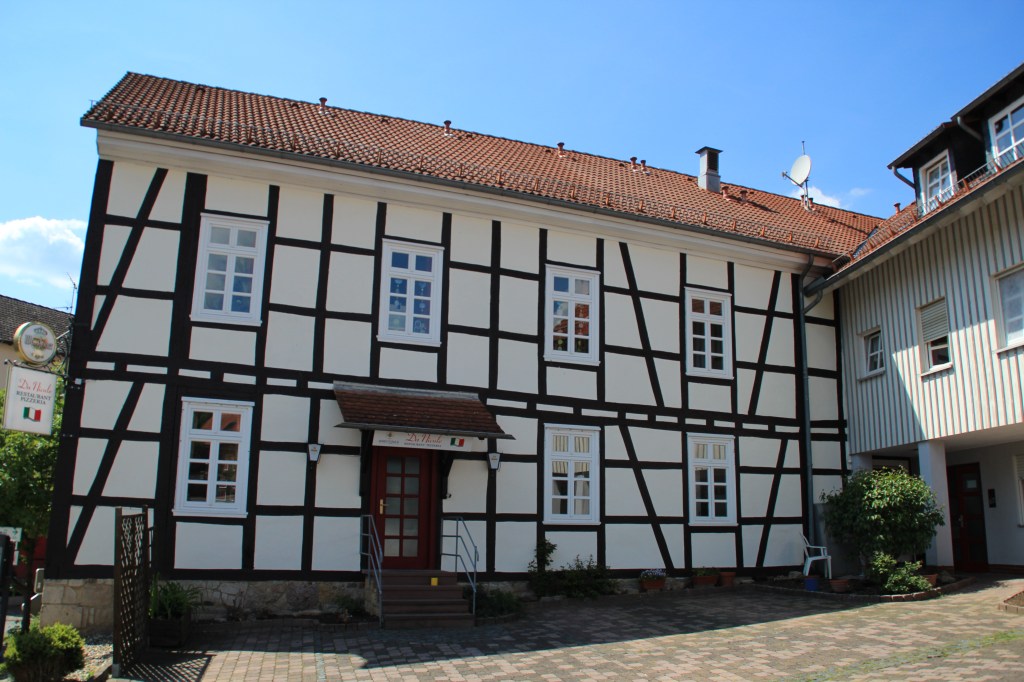
In 1864, his friend and Casino cofounder Wilhelm Prinz passed away. From his estate, Moritz purchased the inn he had owned and renamed it the “Prinz Wilhelm”, in memory of his friend, and took over running the inn and factory there, which manufactured colonial goods, bandy and liqueurs, salt, flour, animal feed, and other local products.
Sometime in the 1860s, probably in 1866, Moritz married Karoline Lieber. She was the daughter of Wolf Lieber and Frommet Rhein, and was born 24 October 1840 in Elsoff, Westerwalderkreis, Rhineland-Palatinate, Germany. They welcomed their first child, Selma Rothschild, on 10 February 1867. Wasting no time, daughter Mathilde Rothschild was born 27 April 1869, and then Alfred Ascher Rothschild was born 4 October 1871. Their youngest child, Willi Rothschild, was born 12 November 1879. There are many possible explanations for the gap between Alfred and Willi. Whatever the reason, I can’t help but think Alfred must have been grateful to finally have a brother!
The 1870s were an interesting decade for Moritz, financially speaking. One the one hand, in 1871 and 1872, he’s on the city list of debtors, owing 12 Thaler 23 Silver groschen and 6 pfennig the first year, and 14 Thaler, 2 Silver groschen and 7 pfennig the second. But by 1877, he appears on the tax list as 5th highest taxed member of the community, behind Levi Kaiser, Selig and David Stern, Liebmann Schönthal, and Abraham Katzenstein. By 1894, it’s obvious Moritz is doing very well. According to the Trade Tax Roll for that year, as an innkeeper and businessman, Moritz paid 24 Marks in taxes, making him the largest trade tax payer after Johanna Blum.
Like most of the people of Vöhl, Moritz was very civically-minded. On 10 May 1880, he co-signed the invitation to found the Beautification Association Vöhl. The inaugural meeting of the newly-formed association was held on 18 May 1880 at 3:00pm in the Restaurant Müller, where it was recorded he paid his membership dues of 0.50 Mark. By 1881, there were 31 members of the association. It appears the association disbanded for several years, but started again in the 1890s. And when it did, Moritz was right there with them. Even when he couldn’t attend the meetings, he paid his dues and made other contributions.
There’s an interesting note from 1883, which states “original list of people living in the municipality of Vöhl who belong to the office as lay judges or jurors [and] can be appointed for 1883”. It’s interesting to note that of the 9 men on the list, he is the only Jew. He must have been held in high regard as a member of the Vöhler community as a whole, not just among his fellow Jews.
In June of 1888, he was fined 1 Mark for “violating the field and corridor regulations.” I have no idea what that means, but I figure as long as he’s not tipping out chamber pots onto the street, as did his father, he’s ahead of the game! In February of 1894 he was fined 2 Marks for violating the tax code. In 1896, he was once again fined 1 Mark for a tax offense.
On 13 December 1888, the Corbach Newspaper reported the following:
On 10 December 1888, the coachman of the Innkeeper M. Rothschild drove travelers to Corbach. On the way, the chaise was met by 4 drunken men. The men struck the glass windows of the chaise — causing glass splinters to shower on the occupants — and treated them with all sorts of insults. The coachman drove away at a trot, leaving behind his hat, which he liked. The investigation is in progress.
I shouldn’t laugh, and I’m sure it was terrifying for the occupants, but that line “leaving behind his hat, which he liked” just makes me giggle. Hopefully the authorities were able to find the perpetrators and deal with them appropriately.
Another article from the Corbach Newspaper, this one dated 13 February 1890:
Vöhl, Feb 12. Our peaceful residents were not insignificantly disturbed by fire signals on Tuesday. There was a fire in the Rothschild basement. The zealous fire crews were soon there, and energetic intervention succeeded in nipping the fire in the bud, even though several barrels of petroleum and other flammable objects were stored in the basement. There were two hoses used in extinguishing the fire.
The Turn of the Century brought some exciting changes. From 14 March 1900 we read, “In yesterday’s municipal election, the following were elected: In Department III, Karl Klingelhöfer; in Department II, Heinrich Bock; in Department I, Moritz Rothschild. The election went smoothly, at least the election campaign wasn’t as hot as it was two years ago. From the voters of Department III, only 18 people took part in the election, all of whom voted for Mr. Klingelhöfer.”
Another change in 1900 was when he was connected to the local telephone system. At the time, a total of 6 people in Vöhl had telephones. It must have been so exciting to know he could pick up the phone and talk to someone without having to travel to them. We with our phones in our pockets and the ability to reach anyone, anywhere, anytime certainly take that blessing for granted. I do, at least.
In 1901, Moritz started advertising with postcards, something that was very popular at the time, and a lot of the card featured images of family life, such as this one:


I think this is just so charming with it’s hints of a bygone era (even then) and the subtle suggestion that a stay in Vöhl will be peaceful, relaxing, and a joy for the whole family.
Throughout the years, according to the Servants Register of Vöhl, Moritz had a long list of servants who worked for him, starting in 1860. Initially, I was going to list them all, since the information for each of them includes their name, their dates of service, where they’re from, and a brief physical description. But there are well over 30 of them. If you’d like to see them, you can view the list on the Synagogue Vöhl website at https://www.synagoge-voehl.de/images/pdf/voe/r/Rothschild_Moritz_Moses1.pdf.
In August of 1902, the following notice appeared in the paper:
Todes-Anzeige.
(Statt jeder besonderen Anzeige.)
Verwandten, Freunden und Bekannten schmerzerfüllt die traurige Mittheilung von dem nach kurzen, schweren Leiden erfolgten Ableben unseres nvergesslichen Gatten und Vaters
Herrn Moritz Rothschild
Vöhl, den 12. August 1902
Die trauernden Hinterbliebenen.
Die Beerdigung findet Donnerstag 3 Uhr statt.
Death Notice
(Instead of any special ad.)
Relatives, friends, and acquaintances are saddened by the sad news of what has happened after a short, difficult time [of] suffering followed [by] the passing of our unforgettable husband and father
Mr. Moritz Rothschild
Vöhl, August 12, 1902
The grieving relatives.
The funeral will be Thursday at 3 p.m.
Such a brief death notice, and yet it is filled with the grief and sorrow the family must have felt. At the time of his death, he and Karoline would have been married about 35 years, their children adults, some with lives and families of their own. Moritz would have been only 69 at the time of his passing. It sounds like he lived a full life, was well-known and well-liked throughout the community of Vöhl, regardless of his religion.
In March of 1904, the following notice appeared:
Voehl, March 15. Yesterday the election of the municipal councilors took place here in the Müller’schen Saale. There were 4 community councilors to choose from. The farmer Daniel Müller was unanimously re-elected in the 1st department and the wheelwright Philipp Müller in the 3rd department. The farmer Hermann Schmidt was re-elected in place of the community deputy David Stern, who left the second division. Mr. Stern was then elected by the 1st Division to replace the late Municipal Councilor Moritz Rothschild. This time the voters were united like never before; After the election ended, people enjoyed themselves for a few more hours with a glass of free beer. I LOVE that they pulled together to unanimously vote for his replacement, then shared a glass of beer to drink to him. He was respected, revered, and missed.
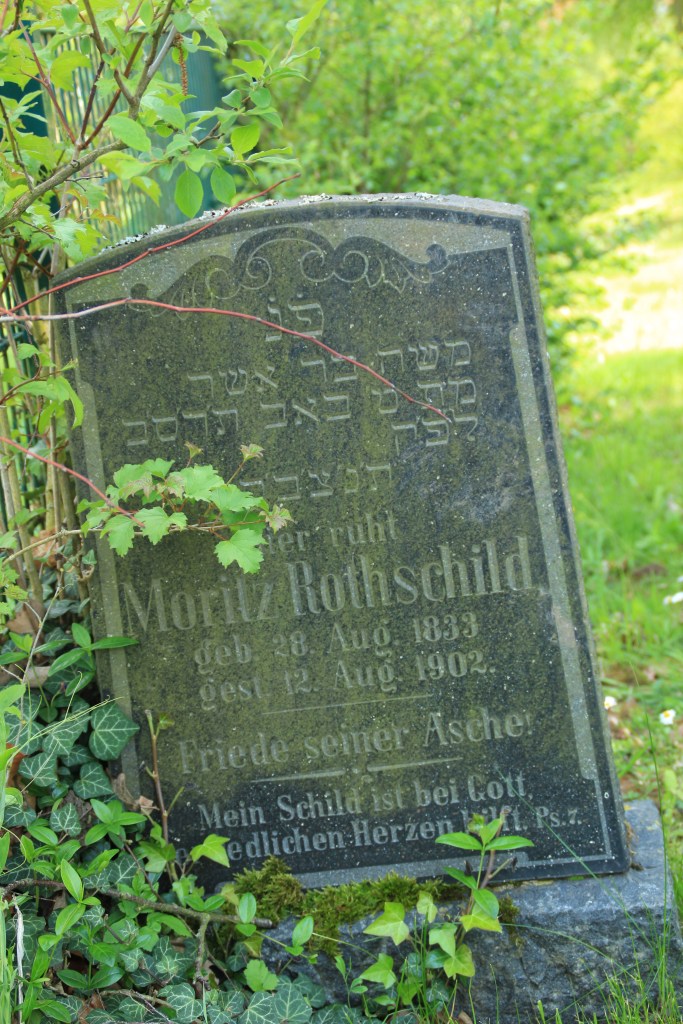
The headstone of Moses Moritz Rothschild sits against the fence in the restored Jewish cemetery on the outskirts of Vöhl. It tilts a bit, but otherwise is in good repair. During the Nazi reign of terror, all of the headstones were removed from this cemetery and stored in a nearby barn. Residents of the community were told to use them for building material. When the war was over, Allied forces ordered the remaining headstones returned to the cemetery. They were all placed roughly where they’d been previously. Only 46 of over 160 were returned. I love that Moritz’ was one of them.
Here rests
Moritz Rothschild
born 28 August 1833
died 12 August 1902
Peace to your Ashes
My shield is with God who saves the upright in heart. Psalms 7:10
Hebrew translation: Here is buried Moses, the son of Ascher. He died on the 9th (day) in Av 662 small count. May his soul be bound in the bundle of life
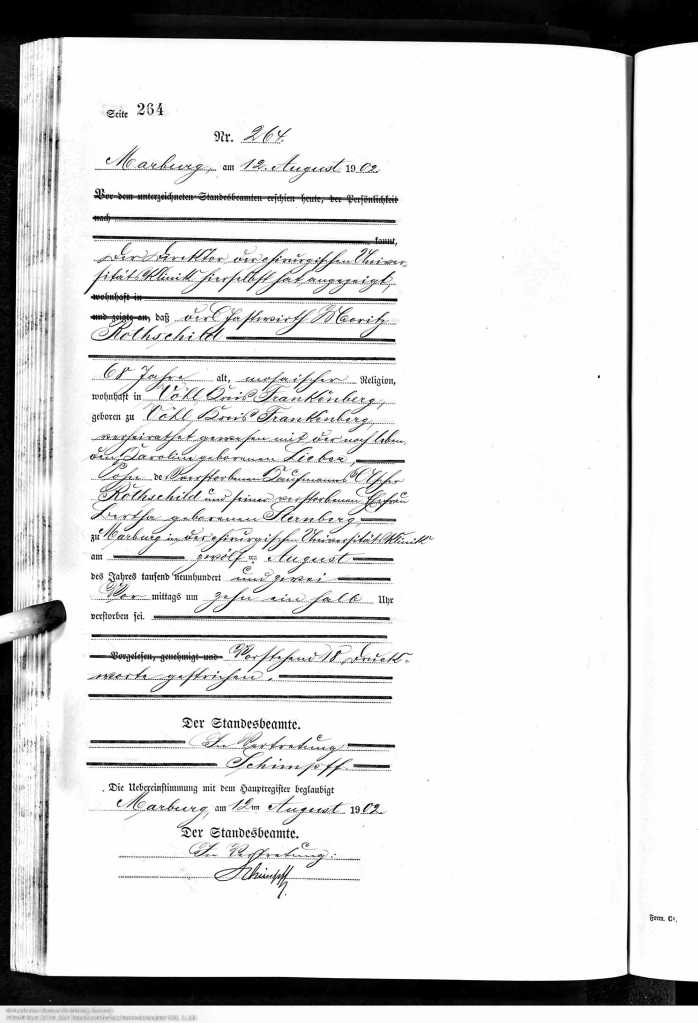
Original data:Sterberegister und Namensverzeichnisse. Hessisches Landesarchiv, Marburg, Deutschland, Europäische Union. Hessisches Hauptstaatsarchiv; Wiesbaden, Deutschland; Personenstandsregister Sterberegister; Bestand: 5691; Laufende Nummer: 915
Moritz’ death record is really interesting to me for a few reasons. First of all, the handwriting is beautiful! Definitely not your run of the mill registrar scrawl
His wife Karoline, about whom we know so little, lived the rest of her life in Vöhl, passing away 1 November 1919. Her death was reported by her son, Alfred, and it’s him we must thank for the information we do have, as her death record clearly lists her age as 79 years 7 days, her religion, her place of birth, her husband’s name, her parents’ names, and her residence at time of death.
Moritz was well loved by everyone in the community, regardless of their religious beliefs. He built a thriving Innkeeping business, which was taken over and run by his son Alfred for decades after his death. I wish I had known him.
Unless otherwise noted, the information regarding Moritz came from the Synagogue Vöhl
website.
There are only 3 members left of this generation; Moritz’ sisters. Their biographies will be posted soon. Until then, I wish you happy!
 Rothschilds of Vöhl and Their Relatives