Ascher Rothschild and Blümchen Rothschild

Ascher Rothschild’s life took some surprising turns following the death of his wife, Sprinza. The first change involved the children, who ranged in age from 15 years old down to just a few days. While Siegmund (16) and possibly Isaac (13) were old enough to help with the family merchant business, the younger children needed looking after. According to the civic records of Vöhl, Ascher turned to his nephew, Ruben Rothschild (1805 – 1895), son of Ascher’s brother, Selig Salomon Rothschild, and appointed him and Ruben’s wife, Helene Sternberg, as guardians. Helene was Sprinza’s sister by birth and niece by marriage, and Ascher and Ruben were involved in numerous business deals together, so this was the perfect solution. Ruben and Helene had married sometime in 1833, so went from newlyweds to instant family in a very short time frame. Ruben and Helene were listed as the guardians of an undisclosed number of Ascher and Sprinza’s children as late as 1841.

In 1835, Heinrich Müller of Vöhl owes Ascher Rothschild a debt of 62 gulden. An auction was held to raise the money owed. Prior to the auction, Mayor Küthe takes as pledge a cow, two oxen, two sheep, and a mother pig. I’m guessing it was common practice to hold items or livestock hostage until after the auction to make sure a debt was paid, one way or the other.

There’s a very interesting notation regarding Ascher for this same year. Dr. Nuss, an inspector of mikvaot in Vöhl (and presumably the surrounding area), inspected the two mikvaot in Ascher’s home. Regarding the one for the men, “… Nuss finds a mikveh which has an elegant appearance and where a device has been installed to direct heated water from the boiler directly into the bath.” As for the women’s mikveh, he deems it not ideal, but recommends that it be used “in the absence of a better one.” I’m not sure which house this refers to. His original home, in which he lived with Sprinza, had burned down, and he was building a new one, which was completed in 1836. Perhaps the new mikvaot had to be inspected as they were being built, to make sure they met the requirements. Regardless, if you had a heated mikveh in 1835, you must have been doing very well financially!
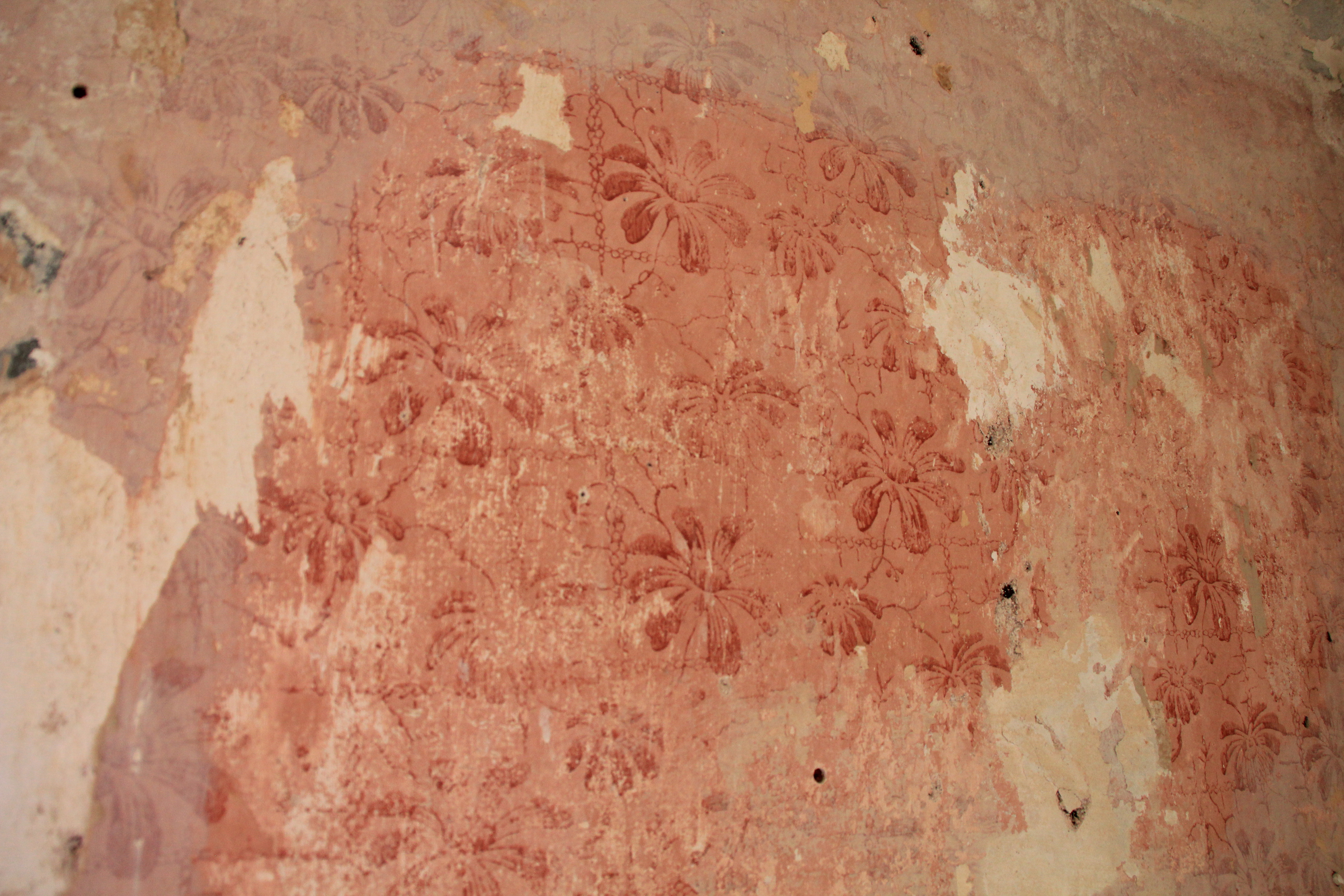
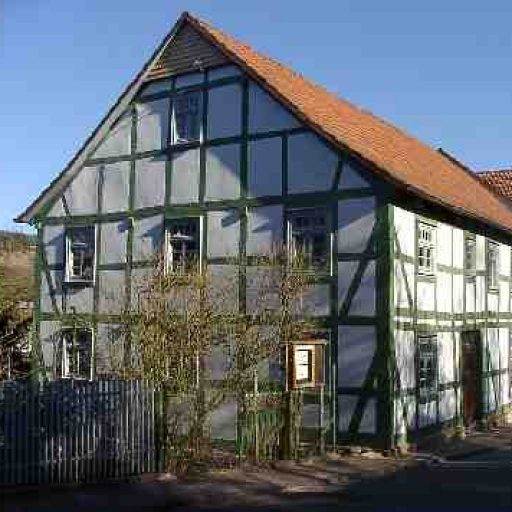
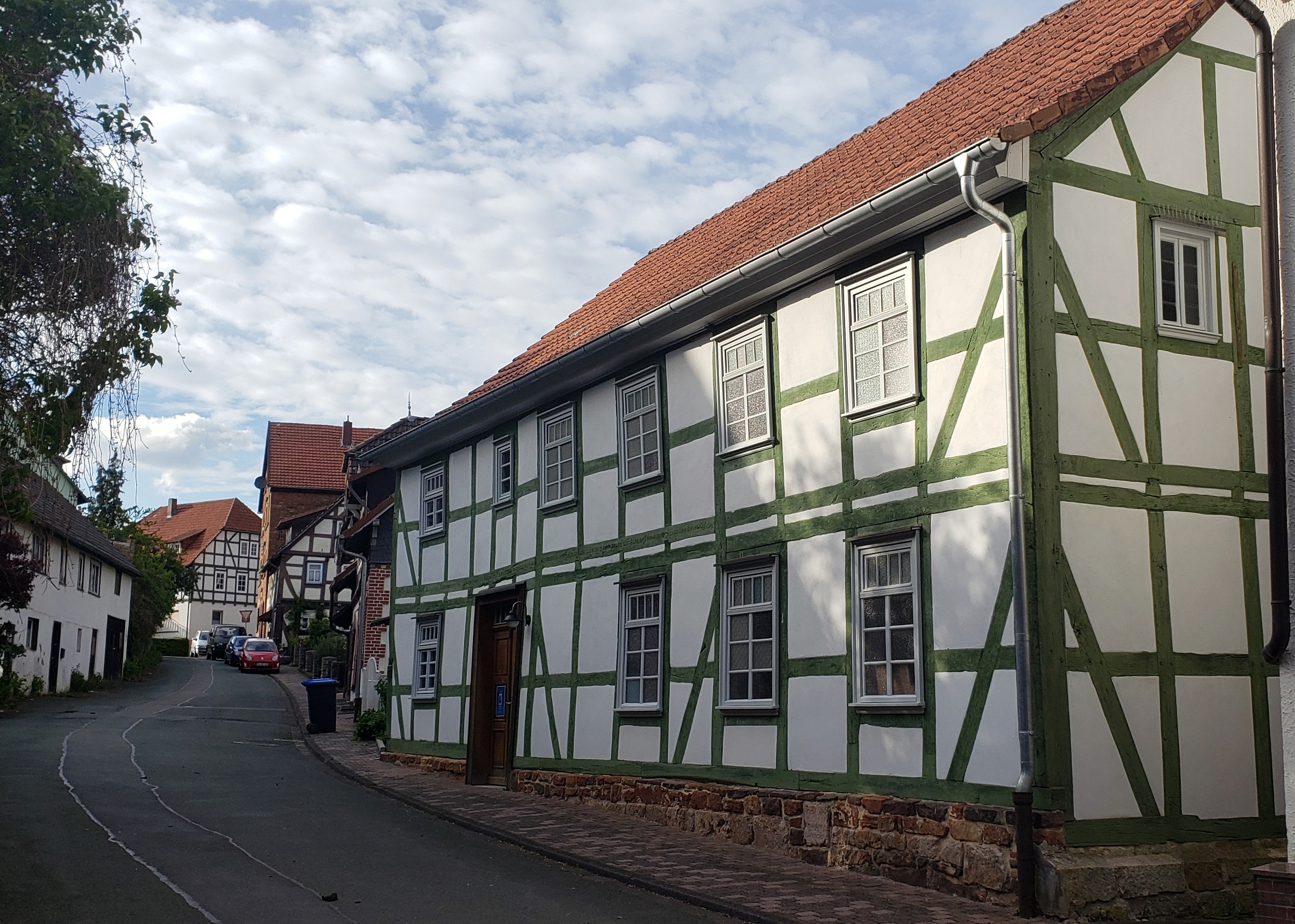
The house. Honestly, I could write an entire blog post just about it! When we arrived in Vöhl in May 2019, Camille and I were thrilled to learn that the current owners were in the process of remodeling it, and had agreed to let us tour it. We spent well over an hour there, and could have spent much longer. They had taken the walls back to the original half-timbered frame filled with mud and straw, much like adobe. They had rebuilt those areas that needed attention. In several places, we were able to see the original hand-stenciled wallpaper. I remember at one point, Camille and I both rested our fingers lightly on some pink flowers, smiled at each other, and commented we could easily see Blümchen putting them there.

In 1836, it was the largest residence in the village. In 2019, it is STILL the largest residence in the village! The ground floor, entered from Arolser Straße, was eventually home to a bakery. While we were there, we found indications of where the the men’s mikveh had been, behind a wall at the far end of the floor from the bakery. Before it was a bakery, the ground floor was home to the Jewish school teacher and his family, and where classes were held. Ironically, it was in the bakery that most of the civic records from the nearby Rathaus met their demise. As WWII was coming to an end, the Nazis realized they had lost. For three days and nights, the ovens went non-stop as the records were carried from the Rathaus to the bakery and burned. My heart weeps thinking how much history for the entire village was lost!
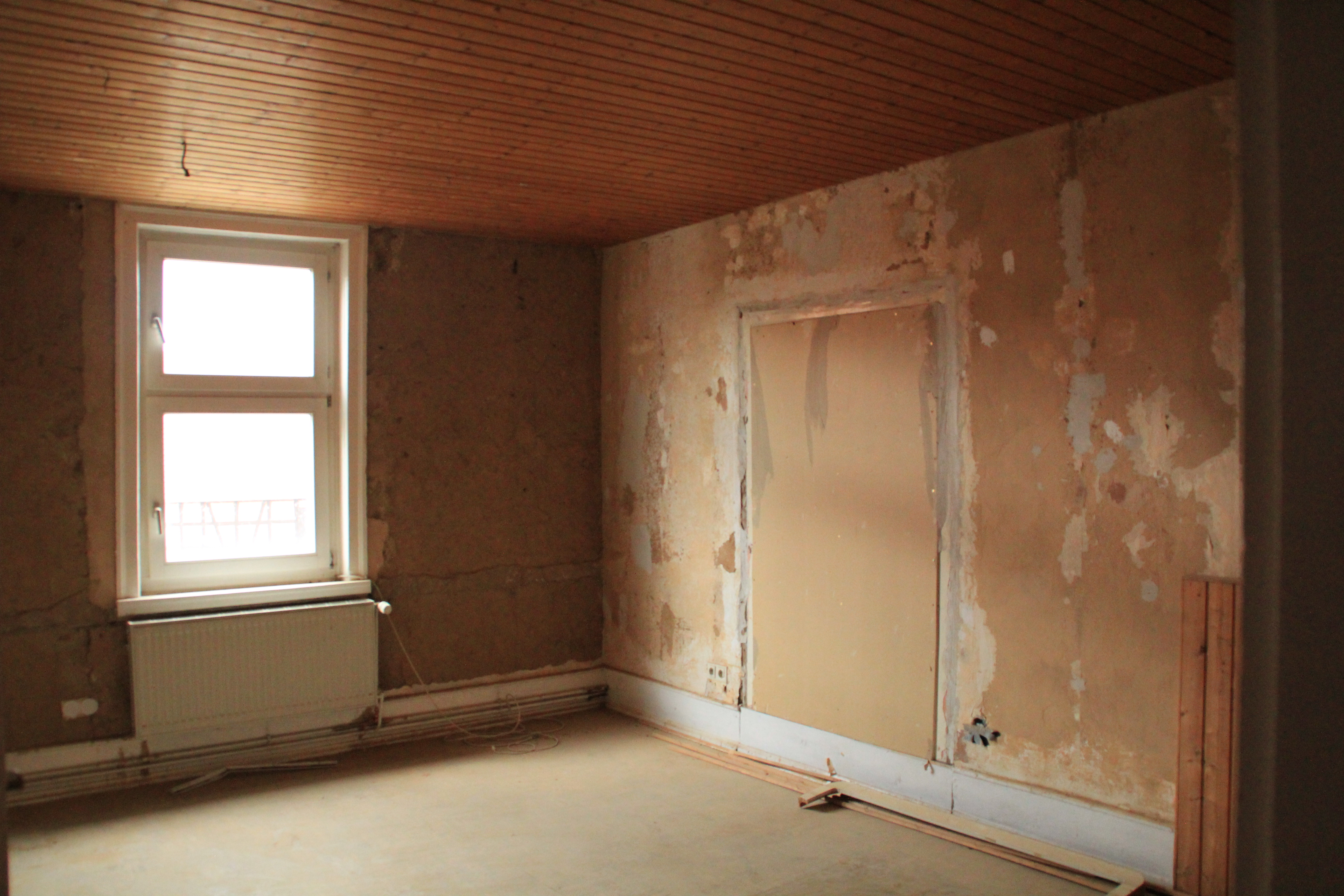
The next floor is best entered from the back side of the house, which was built on a sharp hill. In fact, there’s a narrow lane that separates the house from an erstwhile barn in sad repair. We know that it was built and owned by Ascher Rothschild. The three floors located above the bakery are all identical, and all a rabbit warren of interconnected rooms, all large, all with 10′ ceilings. We kept wandering and wandering and thinking, “Surely we’re done with this floor,” and then we’d find another door! I don’t know how many people Ascher thought would live there, or perhaps he was making sure there was enough space for each of his children to section of a piece for them and their families. Best laid plans…
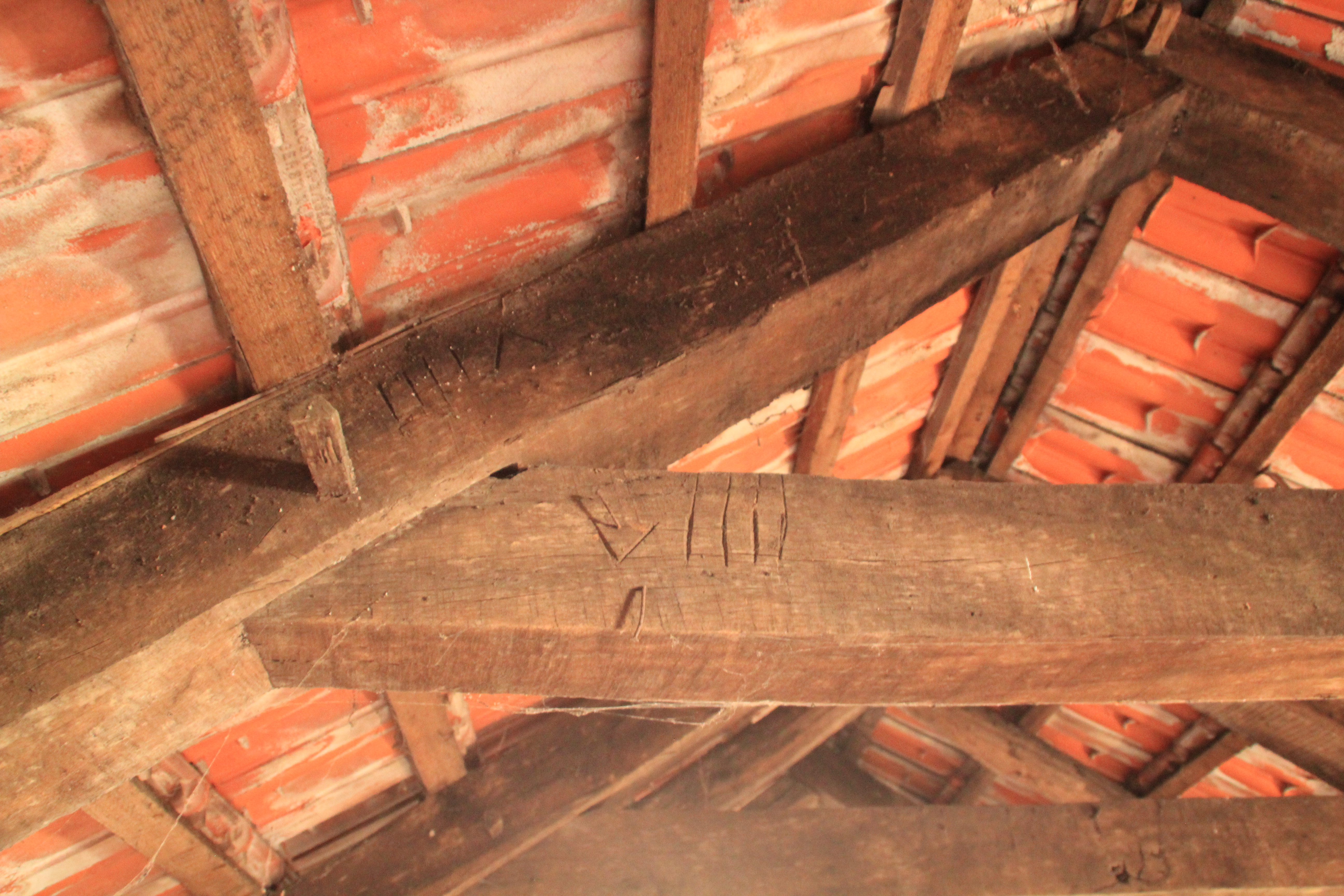
There is a spacious attic above the three floors of living space, and it has a unique feature: built in hanging racks for drying laundry in inclement weather. How ingenious! In case that’s not enough space for you, there is the attic above the attic! Here we could clearly see the construction methods used. The registration marks fascinated me, because the same marks are clearly visible on the posts and beams of the synagogue. I imagine Ascher hired the same builders for both projects. They do good work.

In case you’re wondering just how big this place is, the combined square footage of the three floors of living space is about 8000 square feet!

Sometime in 1835, Ascher married his second wife, Blümchen Sternberg. As previously mentioned, she was another daughter of Joseph Sternberg and Rechel Löb, and a younger sister of Sprinza. Born in about 1810, she was about 25 when they married, and Ascher would have been 46. She would only have been 12 years older than her oldest step-son/nephew, and the prospect of helping to raise some of the children must have been daunting.

Being a stepmother myself, I am in awe of any woman who willingly steps into that role. It is challenging beyond anything you can imagine. I’ve been blessed with three wonderful, handsome, compassionate stepsons. When I married their dad, they were 14, 12, and 9. Now they’re all adults and I could love them more if I’d given birth to them myself. As I’ve told my husband more than once, I wouldn’t trade being a stepmother for anything in the world. I also wouldn’t wish it on my worst enemy. It’s HARD! You have ideas of how it will be, how you think it should be, but you’re stepping into an existing dynamic and have to figure out how YOU fit into it.

Dearest Blümchen, thank you for helping to raise those children, especially my gg-grandfather Abraham Adolph. I have no doubt you influenced his life in countless unknown ways.

Ascher and Blümchen welcomed their first daughter, Auguste Rothschild, on 3 March of 1837, and her birth was announced to Mayor Küthe. Witnesses to the event were Ruben Rothschild and Selig Schönhof, and the midwife was Katharina Schröder. Their second daughter, Adelheid, was born just one day short of 2 years later on 2 March 1839. They had one more daughter, Mathilde, born sometime in 1841.

Ascher’s brother, Selig Salomo Rothschild, passed away in Vöhl sometime in 1840. They must have been close, and I’m sure this was a trying time for all of them.

According to the “Directory of salt requirement of the mayor of Vöhl – Municipality Vöhl after measure of the number of souls and the livestock of the year 1840”, the following belonged to the household of Ascher Rothschild: 12 persons over 8 years old; 4 persons under 8 years old; 1 horse; 2 oxen, cows, and cattle; 0 sheep, goats and pigs.
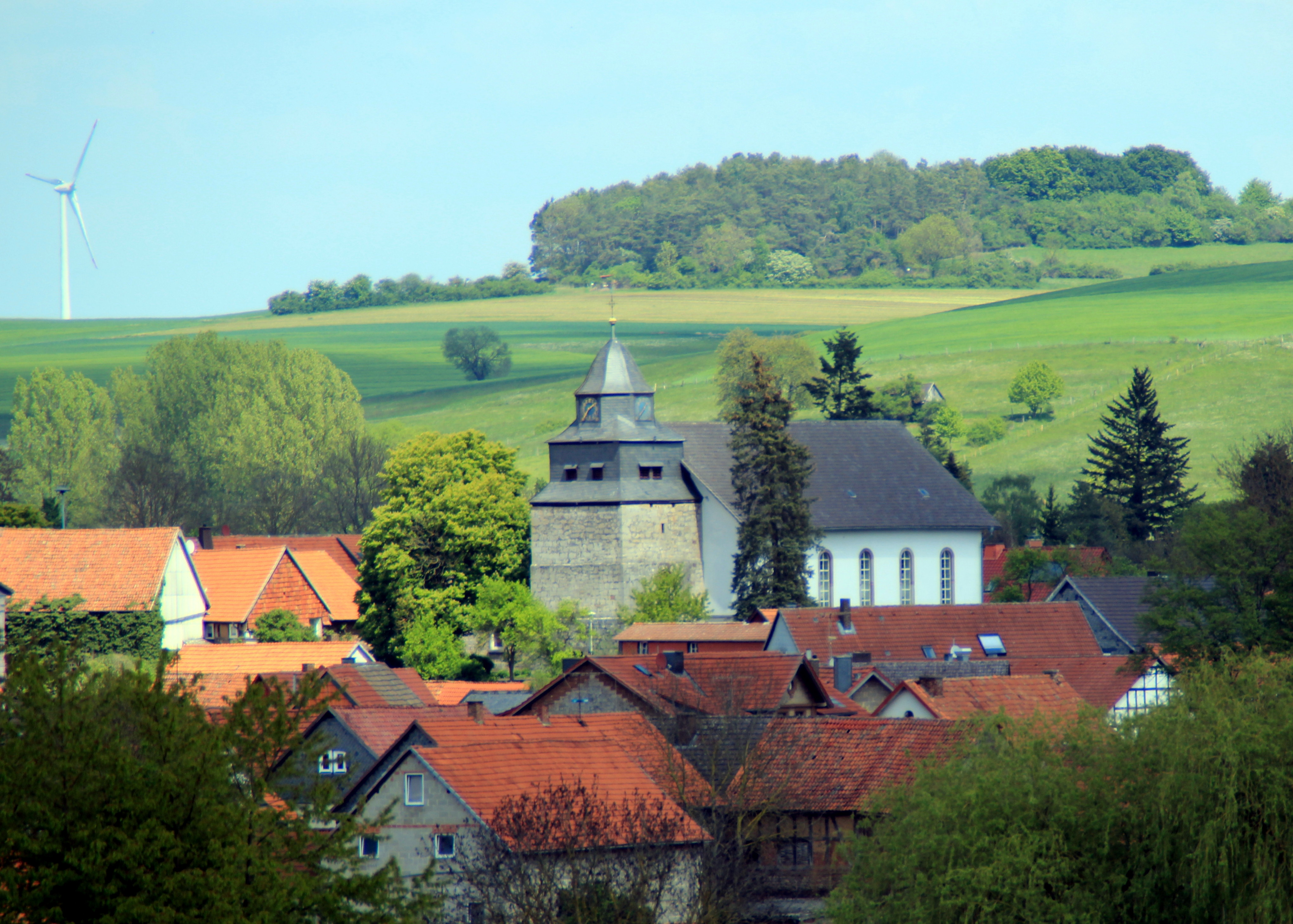
From the windows on the back of Ascher’s house one can very clearly see the local Lutheran church, Martinskirche. This picture was taken from outside of town, but it is literally right in the backyard. Seriously, you could throw a rock. Like most small villages, the church is located in the center of the village. Turns out Martinskirche is directly linked to Ascher Rothschild, because in 1841, he extended a loan of 18,000 Gulden to the municipalities of the Parish for it’s construction. The loan agreement between the Parish of Vöhl and Ascher Rothschild was dated 22 March 1841, and was signed by representatives from the municipalities of Vöhl, Basdorf, Marienhagen, and Asel. It states the Grand Duke had indicated the municipalities were responsible to raise the capital for the church, and “In accordance with Appendix II of the Kreisrath” empowered the communities to borrow the capital of 18,000 gulden. The loan agreement goes on to say “Ascher Rothschild commits himself to advance to the parish of Vöhl the capital up to the sum of 18,000 gulden at four percent annual interest.” “Since for now only a part of the amount requested is necessary, for the time being only five thousand gulden will be advanced on the capital and from now on interest will be paid in four weeks. The rest of the capital will be paid out as needed.” Since four different villages were involved, there’s a provision that indicates the agreement is binding for at least 10 years, and that none of the municipalities can back out before then. Also, since the capital is to be paid out gradually, and it would be too cumbersome to get the entire group back together each time more money is needed, Mayor Wilhelm Prinz of Vöhl was given authority to work directly with Ascher and request the money.

In 2018, Martinskirche celebrated its 175th anniversary, and received a light remodel and some needed updates. When Camille and I were there in May 2019, we attended Sunday service. Maybe not the best idea, as neither of us are Lutheran, and we don’t speak enough German to keep up. But I liked being there, liked knowing my family had a hand in its construction. Thank you, Herr Eisenberg, for allowing us to worship with you, to wander the church after the service, and for your participation of the Förderkreis Synagoge in Vöhl.

Ascher was frequently mentioned in the civic records of Vöhl. Sometimes in a good way, sometimes not. My favorite is from 1844 when a fine was levied against him for contamination of the road. On 15 August, the Grand Ducal Hessian Kreisrath wrote to the Mayor of Vöhl: “Since the indicated evacuation of the chamber pots from the house of Ascher Rothschild, when it is near the road, and the liquid rivulet flows into the gutter of the local road, you must inform Ascher Rothschild that all further downpourings of such disgusting excrement liquid is forbidden by him or his household members under threat of a police charge of 1fg 30kr for any contramotion hereby, and to report the publication of this prohibition within 3 days.”

In 1847, District Chief Koch asks Mayor Wiesemann to report on the reputation of Ascher Rothschild, because he has insulted the field gard Rieglitz from Thalitter. In 1849, there’s more trouble, starting with debts to the Korbach advocate Herr Schumacher in the amount of 12 Reichstalern and some silver groschen, and because of this debt, Ascher Rothschild is seized in February. Ruben Rothschild gives a cow as a pledge, and Ascher is released. Mayor Wilhelm Prinz delayed the required auction and was punished by Judge Koch. There was more trouble in June and July of that year, due to debts of 16 gulden at the trading house Rosenthal in Frankfurt. Legal fees and similar costs of about 46 gulden were added, and Mrs. Rothschild (Blümchen) placed a cow as a pledge, for which Ruben Rothschild vouches. At the same time frame of June and July, Judge Koch learned of an additional debt of 17 Reichstaler 20 Sgr at Mengeringhäuser Stadtcommissär, plus some kreuzer lien fees on garnishment, and instructs the Mayor to hold the pledge auction within 3 weeks. Ascher Rothschild’s wife gives another cow and a horse as pledge. In September, Mayor Prinz is threatened again by Judge Koch for not holding the auction, and threatens him with a fine of 45 Kreuzer if he doesn’t hold it within 3 days. Between then and the spring of 1850, Judge Koch warns Mayor Prinz several times, and fines him at least twice. I have no idea what the relationship was between Ascher and Mayor Prinz, but I can’t help thinking the Mayor must have been well-compensated.

Ascher and Sprinza’s son Selig “Sali” Rothschild became a doctor. In 1855, the civic records of Vöhl indicated Dr. Sali Rothschild reported the death of Mrs. Rothschild. Initially, it was thought this referred to Friedrich Dilsheimer Rothschild, wife of Ascher and Sprinza’s son, Isaac. Further research, however, proves Friedericke lived until 1903. I believe this actually refers to Ascher’s second wife, Blümchen. There is only anecdotal evidence to support this, and it is admittedly slim. Blümchen is never mentioned much, and not at all after 1855. She is not mentioned in Ascher’s death record, so she was deceased before that. Most telling, however, is that upon Ascher’s passing, instead of Blümchen and her daughters continuing to live at the house, the daughters are sent to Mainz where they live with their older half-brother Dr. Selig “Sali” Rothschild.

There are a few other mentions of Ascher in the civic records, day-to-day things like registering a pet dog, being owed money, being asked to provide a loan of 13,000 gulden to the community for an undisclosed reason just a few days before his death. The last information about Ascher is his death record. It lists his age as 79 at the time of his death, putting his birth year at 1780 or 1781. If this is correct, he was 37 when he married Sprinza, and 30 years older than Blümchen. Not completely unheard of, but a bit of a stretch. And as I mentioned in the previous post, I choose to go with his presumed birth year of 1789 as indicated in his marriage record to Sprinza. His death record reads as follows:

According to the allged statement, Ascher Rothschild, and 13 o’clock on January 13, 1859, after a long illness, passed away, and that in the survey and examination of the corpse made today, the following marks of death are recognized and noted to have been: (1) keeping eyeballs from pressure of fingertips; (2) brown, green, and black spots all over the body, especially on the abdomen and genitals; (3) the abdomen swelled. So that he is regarded as dead. Such certifies in Vöhl January 16, 1859, Friedrich Müller, Healing Servant.
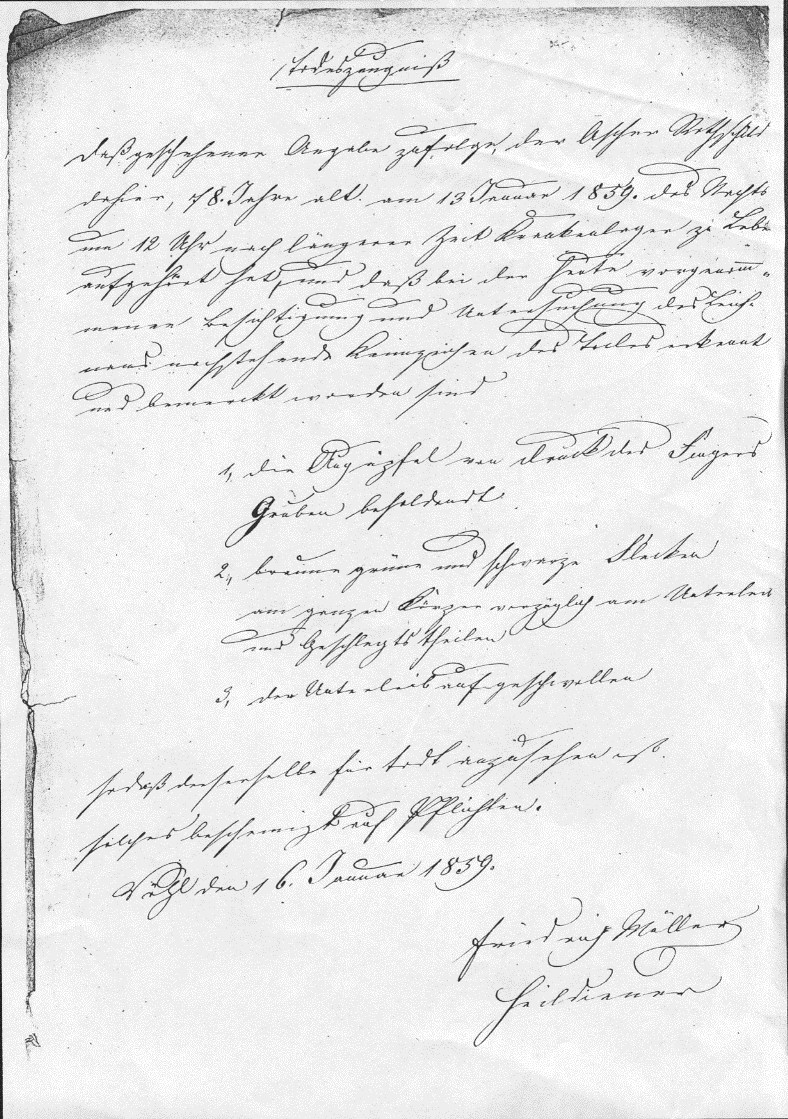
Ten years after his passing, “A. Rothschild’s heirs had an estate sale, which was judicially confirmed by the royal district court on 20 July 1869. The payment of the purchase price shall be made to I. Bayerthal’s widow from Oppenheim.” It’s possible this refers to a different “A. Rothschild”, but I tend to believe it is Ascher. Ascher and and Blümchen’s youngest daughter, Mathilde, married Heinrich Bayerthal of Oppenheim. I have sometimes seen the letters “I”, “J”, and “H” mistaken for each other, and it’s possible Heinrich had another name, perhaps Isaac, or Isiah, or Israel. Again, anecdotal evidence at best.

I have learned so much about the type of person he may have been through these records, and through his legacy, which continues to live in his hometown of Vöhl. He built a school to make sure Jewish children were well-educated. He ran a thriving business as a merchant and as a money lender. He was a scoundrel and had at least one politician in his pocket. And he was generous. I’m very proud to be descended from him.

I was planning to next write about Ascher’s oldest son, Siegmund. Instead, I’m going to write about the synagogue. Seems like the right time. Until then, L’Shanah Tovah!

Ascher Rothschild and Sprinza Sternberg

Ascher Rothschild is my 3rd great-grandfather, and I have been thrilled to find so much information about him. He has definitely left his mark on the village of Vöhl. But before I get too far into the story of Ascher Rothschild, I need to apologize about a typo on my first blog post about Salomon Abraham Rothschild. In it, I referred to Ascher and Sprinza’s marriage record, and indicated Ascher was the 6th child and 2nd son of Salomon Abraham Rothschild, and intimated he was the youngest child. The extract actually says he was the 4th son and 6th child. It doesn’t indicate where he falls in that lineup. I’ve corrected the original post.

There’s a little bit of a mystery about Ascher’s birth year. The marriage record of 19 November 1817 lists his age as 28, meaning he was most likely born in 1789. When he passed away in January of 1859, his death record indicated he was 78 years old, putting his birth year at 1780 or 1781. In this instance, I’m more inclined to believe the marriage record than the death record, so that’s the year I’m going with.

As with the other posts so far, unless otherwise noted, the source of the information regarding Ascher Rothschild comes from the civic records in and around Vöhl, which have been researched and transcribed by Karl-Heinz Stadtler, and can be found at http://www.synagoge-voehl.de/synvoealt/Juden_in_Voehl/index.htm.

In the civic records of Vöhl in 1817, he’s listed as “Rothschild’s heir”, and more than likely refers to the estate of Salomon Abraham Rothschild, who passed away sometime after May of 1816.

Ascher Rothschild was a merchant and a “Geldheber”, or money lender. He was very wealthy. It’s believed that during the course of his lifetime he gave each of his 12 children 3000 Thaler. According to the website www.amason.net, in 1838, two Prussian Thaler were equal to 3 1/2 Gulden. Both were minted in silver. I haven’t been able to figure out what that would be in today’s market, but I suspect it’s quite a bit.

In his research on Ascher Rothschild, Karl-Heinz Stadtler was in contact with a published and respected German researcher named Norbert Hansen. Mr. Hanson provided Karl-Heinz with an excerpt of Ascher and Sprinza’s marriage record. When pressed for details on its origin, Mr. Norbert said it was from the Stadtarchiv of Homberg/Ohm. This makes sense, since this is where Sprinza was born. My attempts to contact and request a copy of the marriage record directly from the Stadtarchiv have gone largely unanswered. I hope that I will, at some point, have the complete record. And, given the handwriting that’s visible, that I’ll be able to find someone who can read it for me! I’m getting better at reading the “alteschrift”, but this is particularly bad.

Sprinza Sternberg was born about 1797 in Homberg/Ohm, the 2nd daughter and 2nd child of Joseph Sternberg (about 1771 – ?) and Rechel Löb. Per the marriage record, Joseph was a “Burger und Roßhändler” or “Citizen and Horse Handler” of Homberg an der Ohm. In addition to Sprinza, Joseph and Rechel were the parents of Breinchen Sternberg Katten (1795 – ?), Isaac Sternberg (1802 – 1886), Helene Sternberg Rothschild (1806 – 1886), Blümchen Sternberg Rothschild (1810 – 1855), and Adelheid Sternberg. You’ll notice two other of the Sternberg sisters ended up with the last name of Rothschild. Blümchen is Ascher’s 2nd wife, and Helene married Ascher’s nephew, Ruben Rothschild. I promise we’ll learn more about them later.

Ascher and Sprinza wasted no time starting a family, and were the parents of 9 children: Sigmund Salomon Rothschild (1818 – 1877), Isaac Rothschild (1820 – 1897), Selig “Saly” Rothschild (1822 – 1875), Bertha Rothschild Ballin (1824 – 1882), Jacob aka James Otto Rothschild (1825 – 1893), Friedericke Rothschild Eberwein (1827 – 1911), Abraham Adolph Rothschild (1829 – 1921), Rebecka Rothschild Emanuel (1831 – 1883), and Moritz Moses Rothschild (1833 – 1902). Isaac, Bertha, Jacob and Abraham all moved to the States. Sigmund moved to Offenbach am Main, and Selig moved to Mainz. Friedericke moved with her husband all over Hesse, spending time in Burg Gemünden, Offenbach am Main, and Mörfelden, eventually ending up in Friedberg. Rebecca and her husband lived in Frankfurt. Of the 9 children born to Ascher and Sprinza, only the youngest, Moritz Moses Rothschild, stayed in Vöhl.

Sprinza’s name has many, many variations. Sprinz, Schprintz, Spring, Sophie, Sophia, Iris, and Bertha. The first three are all easily explained, and Sohpie/Sophia was likely her civilan name. Iris was on a transcription provided by ancestry.com, so I take that one with a grain of salt. The only place I saw her listed as Bertha was on Moritz’ death record. Since Moritz was raised primarily by his aunt/step-mother Blümchen, I’m wondering if “Bertha” is perhaps Blümchen’s civilian name. Or maybe Bertha was her middle name and it just wasn’t written down anywhere else.

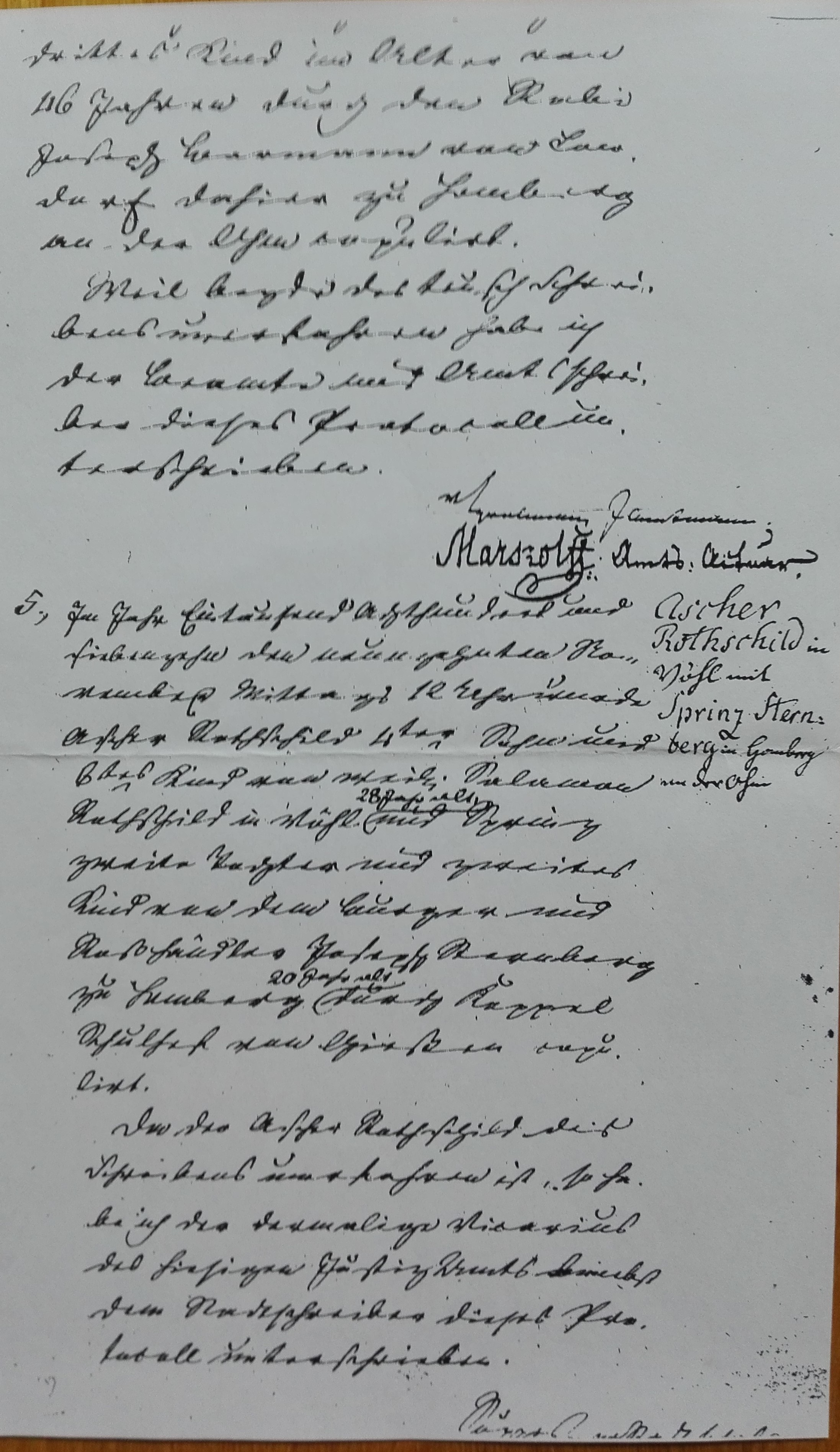
You know, it’s funny how things work. It’s been a couple hours since I started this, and I just received an email from my friend Karl-Heinz which includes not only the full marriage record but also a transcription! You, dear reader, get to see the image as well as get a translation. Let’s see what we learn!

In the year one thousand eight hundred and seventeen on the nineteenth of November at noon, Ascher Rothschild, the 4th son and 6th child of ________ Salomon Rothschild in Vöhl, 28 years old, and Sprinz, the second daughter and second child of the Citizen and Horse Handler Joseph Sternberg of Homberg, 20 years old, were by Koppel Schul____ copulated [married] from Gießen.

Since Ascher Rothschild is inexperienced in writing, the town clerk of the local judicial office has signed this protocol for him vicariously.

So, now you know what I know about their marriage!

Ascher Rothschild heavily financed the construction of a school to be used for the education of the children of the Jewish community, and it was completed 17 July 1827. I truly believe this speaks to his character: a man who couldn’t sign his own marriage record built a school to benefit future generations of Jewish children. The deal was that Ascher would provide the bulk of the money needed, and each Jewish family in the community would make monthly payments to repay the loan. All seemed well until after the school was completed when a gentleman referred to only as “The Basdorfer” protested. Whether he changed his mind or felt he was being overcharged is unclear. The Marburg City Archives for 1827 state, “A man named Rothschild, who had two first names, of which the second could be ‘Ascher’, is a board member of the Jewish Community. In this capacity, he has to deal with the refusal of ‘The Basdorfer’ to contribute to the costs of the Jewish school finished some time before.” Also in 1827 he, and others, give an explanation about the financing of the Jewish school to the district office.

In 1829, the Jewish school was dedicated as a synagogue. The school teacher, who had been living at the school, moved into Ascher’s home with his family, and school was taught there from that point forward. The issue with “The Basdorfer” really comes into play at this point, because the chairs — referred to sometimes as stalls — were paid for monthly.

In May 2019, it was at the invitation of the Förderkreis Synagoge in Vöhl, e.v., to join their 20th anniversary Jubilee. There were four of us from the States: Geoffrey and Daniel Baird, my cousin Camille Calman, and me. The Bairds ancestors, the Frankenthals, lived next door to our ancestors the Rothschilds. It was fun to get to know our “neighbors”. Both Geoffrey and Daniel had been there before, but this was a first for Camille and me. We entered the sanctuary with it’s robin’s egg blue cupola ceiling dotted with gold stars, it’s stone floors, and a women’s balcony surrounding it. Camille and I took a moment to breathe it in. Karl-Heinz walked past us, striding purposefully just past the first row of chairs, turned right and walked to the first chair on the row. With a huge grin on his face he said, “Hier ist Platz Nummer Eins.” Here is seat number one. We were confused, so he explained.

photo by Daniel Baird

In 2000, less than a year after the formation of the Förderkreis, Ascher’s great-grandson Richard Rothschild and his wife Gerda came back to Vöhl for a visit. Upon entering the synagogue, Richard made his way to where Karl-Heinz now stood, and announced “Platz Nummer Eins” was the hereditary seat for the Rothschild family. After a few minutes in the sanctuary, Camille and I went upstairs, realized the header had numbers painted on it. The women and children also took part in this seating hierarchy, it seems. It truly was a transformative moment for me to sit under that number, knowing my 3rd g-grandmother had sat there with her children, including my gg-grandfather. And to sit there with Camille, who is descended from both of Ascher’s wives, was just the icing on the cake!

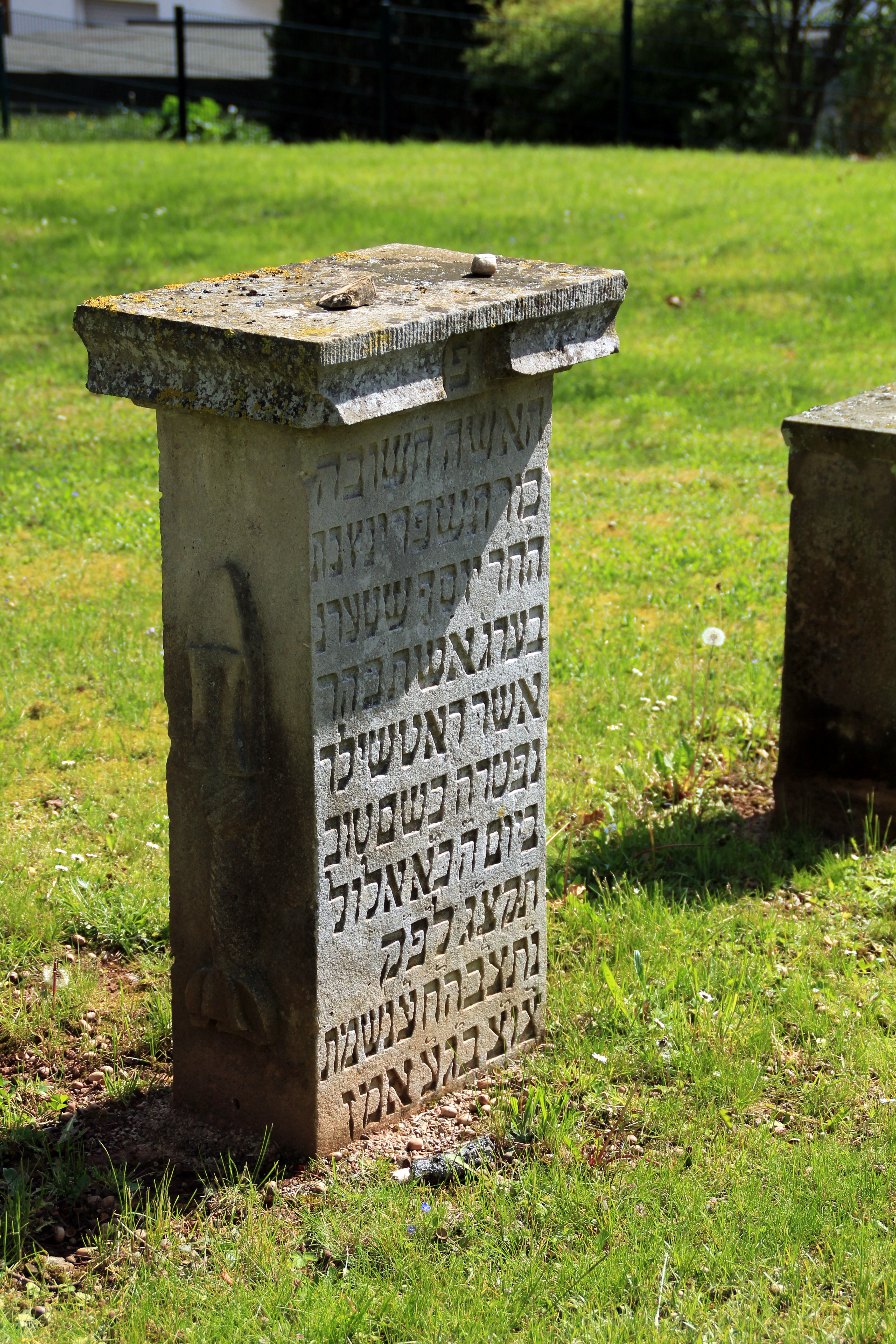
Ascher and Sprinza’s youngest son, Moritz Moses Rothschild, was born 28 August of 1833. Just 8 days later, on 5 September 1833, Sprinza passed away, probably due to complications in childbirth, I would imagine. Ascher ordered a veritable monolith of solid granite, about 3 feet high, 12″ thick and nearly 18″ across. It is, without question, the most striking headstone in the Jewish Cemetery of Vöhl, standing out from all the rest. Thanks to the Baird brothers and also to the kind people on the Facebook group “Tracing the Tribe”, it reads as follows:

Here lies the esteemed woman Shprintz daughter of Yosef Sternberg, wife of Ascher Rothschild. Died with good name on Thursday 21 Elul 5593. May her soul be bound in the bond of the living, her soul resting with the righteous men and righteous women in Paradise.

Aside from making such a statement, there’s another reason this headstone is so special. The Jewish Cemetery in Vöhl served the Jewish community there for over 100 years. During WWII, the Nazis ordered all the headstones removed to a nearby barn. The non-Jews of the area were told to use them for building material. At the end of the War, when the Allies came to the area, the people were told to restore the cemetery as much as was possible. A photo had been taken of it in the late 1930s, and the headstones were returned as close to their original location as was possible. Only about 48 headstones made their way home. While there are a few other Rothschild headstones there, Sprinza is my only direct antecedent.

While we were there, Camille photographed every headstone that was still legible, and created memorials for them on findagrave.com.

I wish I knew more about Sprinza, about who she was. All I know for certain is she was beloved. Following her death, six granddaughters and 1 great-niece were named Sophie.

In our next post we’ll learn more about Ascher, as well as his 2nd wife Blümchen Sternberg. In the meantime, if you’d like to learn more about my trip to Vöhl, you can read my “Tagebuch” on the Synagogue Vöhl website.

Giedel Rothschild Heinemann-Stern, 1778 – 1861

Sometimes, as is the case with Giedel’s sister, Märle, there’s a limited amount of information. Sometimes, as you’ll see when we get to Adolph Rothschild, there’s more information than you know what to do with. And sometimes, as is the case with Giedel, there’s a lot of information, but much of it doesn’t make sense, so you just have to sort through it as best you can, and decided which pieces to run with.

Aside from the fact that she’s the daughter of Salomon Abraham Rothschild, the information about Giedel, as found at http://www.synagoge-voehl.de, is limited to the following:

Giedel Rothschild
geb . 1788 ?
gest. nach 1861
Sie heiratete am 11.Oktober 1800? Kain Heinemann-(Stern) in Niedenstein

Born about 1788, died after 1861, and got married on 11 October 1800 to Kain Heinemann-Stern.

Recently I found a book by Karl E. Demandt entitled “Bevölkerungs- und Sozialigeschichte der jüdischen Gemeinde Niedenstein 1653 – 1866.” This is a fantastic reference book regarding the Jewish community of Niedenstein. Pages 188 – 192 are about the family of Kain Heinemann-Stern.

Kain was the son of Sara Itzig and Kallmann Heinemann. He was born in December 1763 and passed away sometime between 1849 and 1858. Kain and Giedel were the parents of Belie (3 November 1801), Solke (1 April 1803), Abraham (23 January 1805), Röschen (9 June 1806), Geldchen (7 January 1809), Kallman (15 October 1810), and Merle (6 September 1812).

According to this well-researched book, Kain and Giedel appear in numerous documents together throughout the years. And this is where you see what I mean about having to pick and choose information.

The civil register of 1812 lists her as Giedel nee Abraham. My personal belief for this one is that it may be a play on Jewish Patronymics, which could have been written “Giedel bat Abraham”, meaning “daughter of”, and referring to her father’s middle name.

Another civil register, this one from 1823, lists her as Jette (Henriette) Abraham from Vöhl.

The registry office extract from 1828 lists her as Getel Salomon, while the one from 1812 says her birth name was Giedel Blaut. Other records list her as follows: Giedel Kugelmann (1804), Giedel Abraham and Giedel Blaut (1812), Giedel Abraham (1823), Giedel Salomon (1828), Giedel Rothschild (1829), Giedel Abraham (1843), and Giedel Rothschild (1861, 1894, and 1897).

All of these names (Giedel, Guttle Güttel, Jette, etc) are listed as the wife of Kain Heinemann-Stern. It is unlikely that he married so many different women with the same — or similar — first name. And while the last names of Rothschild, Abraham, and Salomon make sense, I have no idea why Kugelmann and Blaut would sometimes be assigned to her. According to familysearch.org/wiki, “Before the 1800s, the use of a family name by Jews was left to the discretion of the individual. Jews in Germany followed the custom of using only a given name and the name of the father, such as Isaac son of Abraham. Most Jews did not adopt hereditary family names until required to do so by law. In 1790 Baden was the first German state to require fixed surnames. Preußen issued an edict on 11 March 1812 that required permanent family names be adopted within six months. Compulsory surname laws were enacted in the German states of Bayern and Mecklenburg in 1813 and 1814. By the 1820s, most small German states had extended civil rights to Jews and required them to adopt surnames.”

To add to the confusion that is Giedel, many of the records list her birth year ranging from 1769 – 1788, nearly a 20 year span. We women have been known to lie about our age from time to time, but this seems a bit extreme to me. The only thing that makes sense to me is that record keeping in the early 1800s wasn’t an exact science (still isn’t, truth be told), and we just have to make do with what we’ve got.

Given the ages and birth years of her children, the birth year that makes the most sense for Giedel is 1778. This put her at 22 when she got married, and 23 when her daughter Beile was born.

In 1858, and again in 1861, the widow of Kain Heinemann-Stern was assessed a fee of 14 thalers as a “Pensioner in the 20th class.” 1861 is the last mention of her amongst the living, so it can be safely assumed she died not too long after that.

The next post will be about Selig Salomon Rothschild‘s youngest son, Ascher Rothschild.

Märle Rothschild Stern, about 1775 – ?

What we know about Märle Rothschild is limited to her father’s name, her husband’s name, her children, her presumed birth year, and that she lived in Vöhl. She was the oldest known daughter of Salomon Abraham Rothschild. She was presumably born in Vöhl around 1775. Unless otherwise noted, the information for Märle comes from www.synagoge-voehl.de.

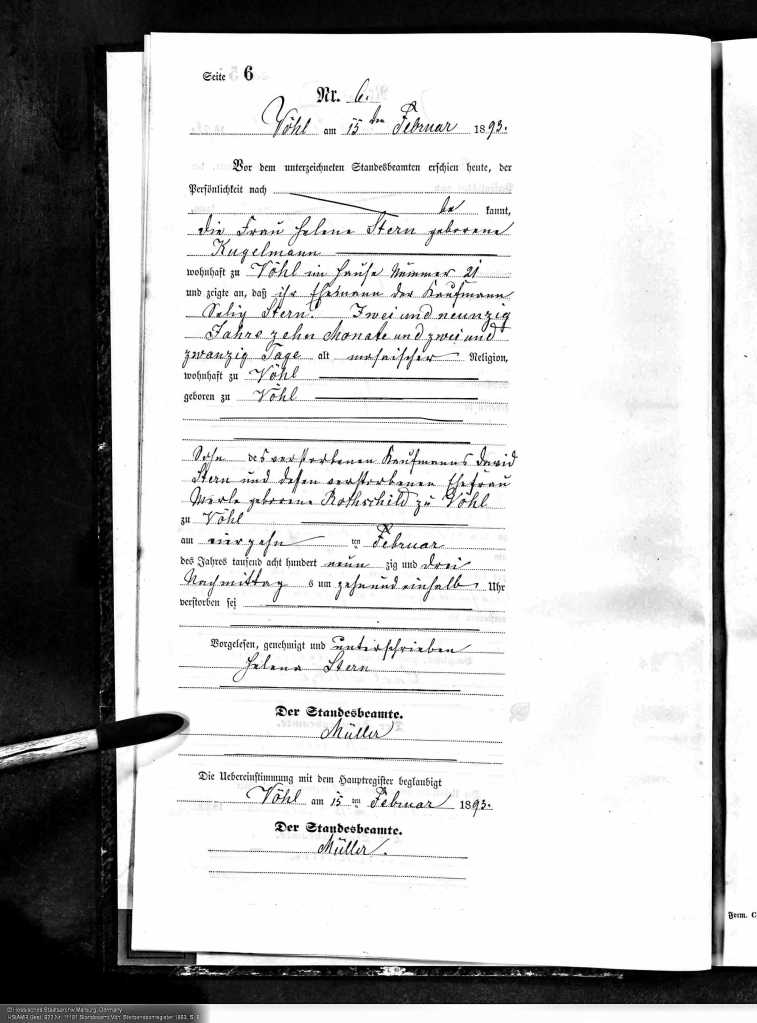
The only documented information I’ve found about her is from 15 February 1893 on the death record of her son, Selig Stern. “Sohn der verstorbenen Kaufmann David Stern und seiner verstorbenen Ehefrau Märle geboren Rothschild zu Vöhl.” “Son of the deceased merchant David Stern and his deceased wife Märle born Rothschild of Vöhl.”

She married David Isaac Stern, the presumed son of Isaac Simon Stern. Since there are no records to go by, it’s estimated David and Märle were married in 1798, because in 1799 their son Simon Stern was born in Vöhl. They had a second son, Selig Stern, born in Vöhl 25 March 1801. Their 3rd son, Bär Stern, was born in Vöhl in 1805.

I haven’t been able to find out when she died, or if she died in Vöhl, though I suspect she did, since her children and grandchildren were born there.

Next up, we’ll learn about Märle’s sister, Giedel Rothschild Heinemann-Stern.

Selig Salomo Rothschild, 1770 – 1840

Selig Salomo (or Salomon) Rothschild is the oldest son, and presumed oldest child, of Salomon Abraham Rothschild. I say “presumed” because we know Salomon Abraham Rothschild had at least 6 children, two of which were sons. All other known children are younger than Selig. Selig was born about 1770 in Vöhl. The information for Selig Salomo Rothschild comes from www.synagoge-voehl.de.

Selig married Ranchen Regine Rubino probably around 1796. Ranchen was born about 1776, and we don’t have any other information about her at this time. Their oldest daughter, Betti Belchen Rothschild was born sometime in 1797 in Vöhl. Son Isaak Rothschild was born in Vöhl in 1799. His records have often been combined with those of his cousin, Isaac Rothschild (born 1820), and you’ll learn more about that in Isaak’s blog post. Other children born to Selig and Ranchen were Mathilde (1801), Minna (1803), Ruben (1805) and Abraham (1808).

Selig’s profession was “Geldheber”, or money handler, like is father. It’s quite possible he took over the family business, or at least part of it. Sadly, it doesn’t sound like he was very good at managing money, because on 19 October 1831 he appeared before the court in Vöhl regarding a debt. Associate Judge Koch ruled against him on seizure for 65 thaler of debt that he owed to a man named Wittmer, possibly from Mahlberg or Marburg. In 1833, he owed a sum of 375 fg (not sure of the denomination) to Sim (probably Simon) Kugelmann, who filed a complaint against Selig. Associate Judge Koch ordered seizures and an auction. The following items were seized: a cow, a bureau, a “Kannbeh”, a “Komote”, and “Swey Dische”, all from the living room. Unfortunately, I have not been able to find any suitable translations for the three items in quotation marks. I suspect “Komote” is actually “Komode”, which is a chest of drawers which was quite decorative and popular in the 18th century. “Swey Dische” to me sounds like “zwei Dische” or “two dishes”. Perhaps decorative platters?

Despite his personal financial difficulties, Selig was the treasurer for the Jewish Community Board. In 1824, he is mentioned in a letter from the district administrator, in which the latter asks representatives from Altenlotheim, Höringhause, Eimelrod, and Vöhl to meet with Selig Rothschild to elect deputies. This implies he had a leadership position in the local Jewish community.

In 1827, in his capacity as a board member of the Jewish Community, he has to deal with “the refusal of the Basdorfer” to contribute to the cost of the recently completed Jewish school. Selig’s brother, Ascher, also a money handler, heavily financed the building of the Jewish school in Vöhl, with the understanding that it would be for the benefit of the Jewish community as a whole, which encompassed the surrounding villages, such as Asel and Basdorf. All members of the Jewish community agreed to contribute to the cost, thereby repaying Ascher. Once the school was complete, one of the Jews from Basdorf tried to renege, and Selig had the task of dealing with him.

In 1829, the Jewish schoolhouse was dedicated as a Synagogue. In 1834, Selig is still a member of the Jewish Community Board, and is signed on a letter of payment of the stalls in the synagogue. It is believes this refers to the seats, and that each Jewish family was assigned a seat. Ascher Rothschild, for example, had Seat #1 in the sanctuary. In the women’s balcony, you can still see where the seat numbers were painted on the support beam.

According to the “Directory of the Salt Requirement of the Mayor Vöhl — Municipality Vöhl After measure of the Number of Souls and the Livestock of the Year 1840” the following belong to the household of Selig Salomon Rothschild: 4 persons over 8 years old; 0 persons under 8 years old; 0 horses; 2 oxen, cows, and cattle; 9 sheep, goats, and pigs.

There is no mention of Selig after the 1840 salt tax, so it’s presumed he died sometime that year. At the time of his death, he was survived by his wife, all 6 children and 5 grandchildren. An additional 11 grandchildren born after 1840, three of whom were named Selig.

His wife, Ranchen, survived him by nearly 20 years, passing away in Vöhl on 30 January 1860. On 1 February 1860, the following notice was submitted to the City Registrar’s office in Vöhl:

That according to the alleged statement, Regine Rothschild, 84 years old, suffered from arthritis.  In Vöhl on 30 January 1860 at 8 o’clock, after several weeks of illness, life has stopped, and that during today’s inspection and investigation of the corpse, the following characteristics of death have been noticed:

  1. Coldness and rigidity of the whole body
  2. Peculiar corpse smell.
  3. Turbidity of the cornea and immobility of the pupils.

Blue-green coloring of the abdominal wall and other signs of internal…, so that she is to be regarded as dead, this attests to duties.  Vöhl, d. 1st of February 1860, Sulzmann.

The next post will be about Selig’s sister Märle Rothschild and her husband David Isaac Stern.

Salomon Abraham Rothschild, 1747 – 1816

The first recorded Jews in Vöhl were Ascher Rothschild and Seligman Rothschild, listed as homeowners in 1705. To be registered home and land owners, these men needed to have been born by about 1680 at the latest. As yet, I haven’t found the connection to these early Rothschilds, though I’m sure there is one. I suspect one of them is the grandfather of Salomon Abraham Rothschild. I wish there were more records from the late 1600s and early – mid 1700s, but most of the records were burned near the end of WWII.

Salomon Abraham Rothschild was born about 1747 in Vöhl. This birth year is an estimate and is based on the genealogical guideline of about 30 years between generations. The civic records of the area indicate there was, in 1747, a registered landowner of the same name in nearby Basdorf. For this to be the same person, he would need to have been born around 1725 or earlier, putting him at about 50 or older when his first recorded child was born. While not impossible, this seems unlikely. This family seems to have a passion for re-using names, so it’s possible the Salomon Rothschild in Basdorf is a relative. I briefly wondered if it could be his father, but Jews weren’t normally named for someone who was still living.

His profession is listed as “Geldheber” which translates to “money collector”. He was most likely a money lender, which was a common profession for Jews at that time.

We know that Salomon was married, but no records concerning his wife have been found yet. The marriage record for his son, Ascher Rothschild, lists Ascher as the 4th son and 6th child, so we know there were at least 6 children.

Salomon’s known children were:

Selig Salomo (or Salomon) Rothschild. He was likely born around 1770. He married Ranchen Regine Rubino. Selig died sometime in or after 1840.

Märle Rothschild was born about 1775. She married David Isaac Stern. There is no known death date for Märle at this time.

Giedel Rothschild was born about 1778. She married Kain Heinemann Stern in Niedenstein. Giedel passed away in 1861.

Ascher Rothschild was born in 1789. He married (1) Sprinza Sternberg of Homberg/Ohm. She passed away in 1833. Prior to 1836, Ascher married (2) Blümchen Sternberg, Sprinza’s sister. Ascher passed away in January 1859.

The information for Salomon Abraham Rothschild comes from www.synagoge-voehl.de.


Brotmanblog: A Family Journey

Adventures in Genealogy