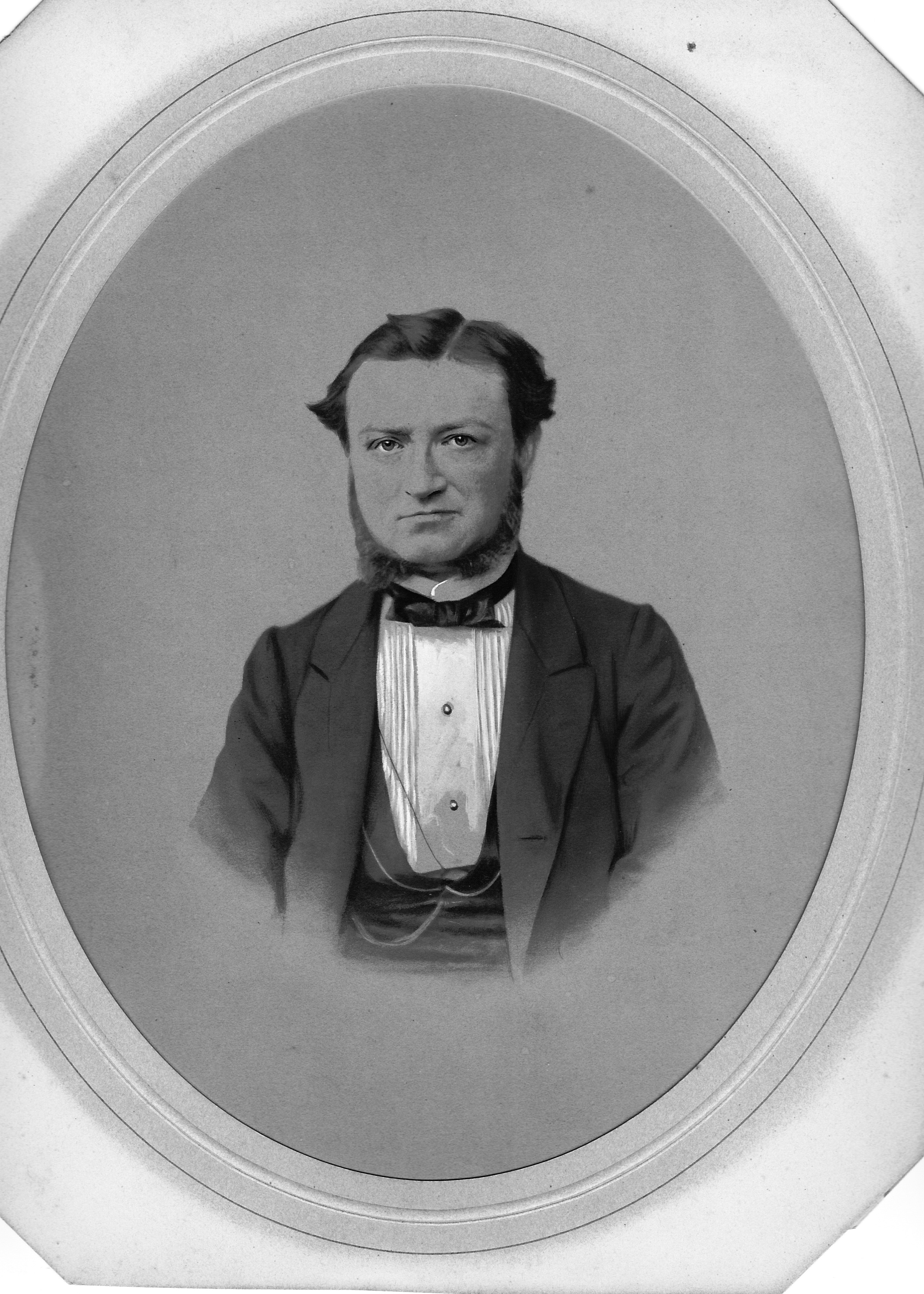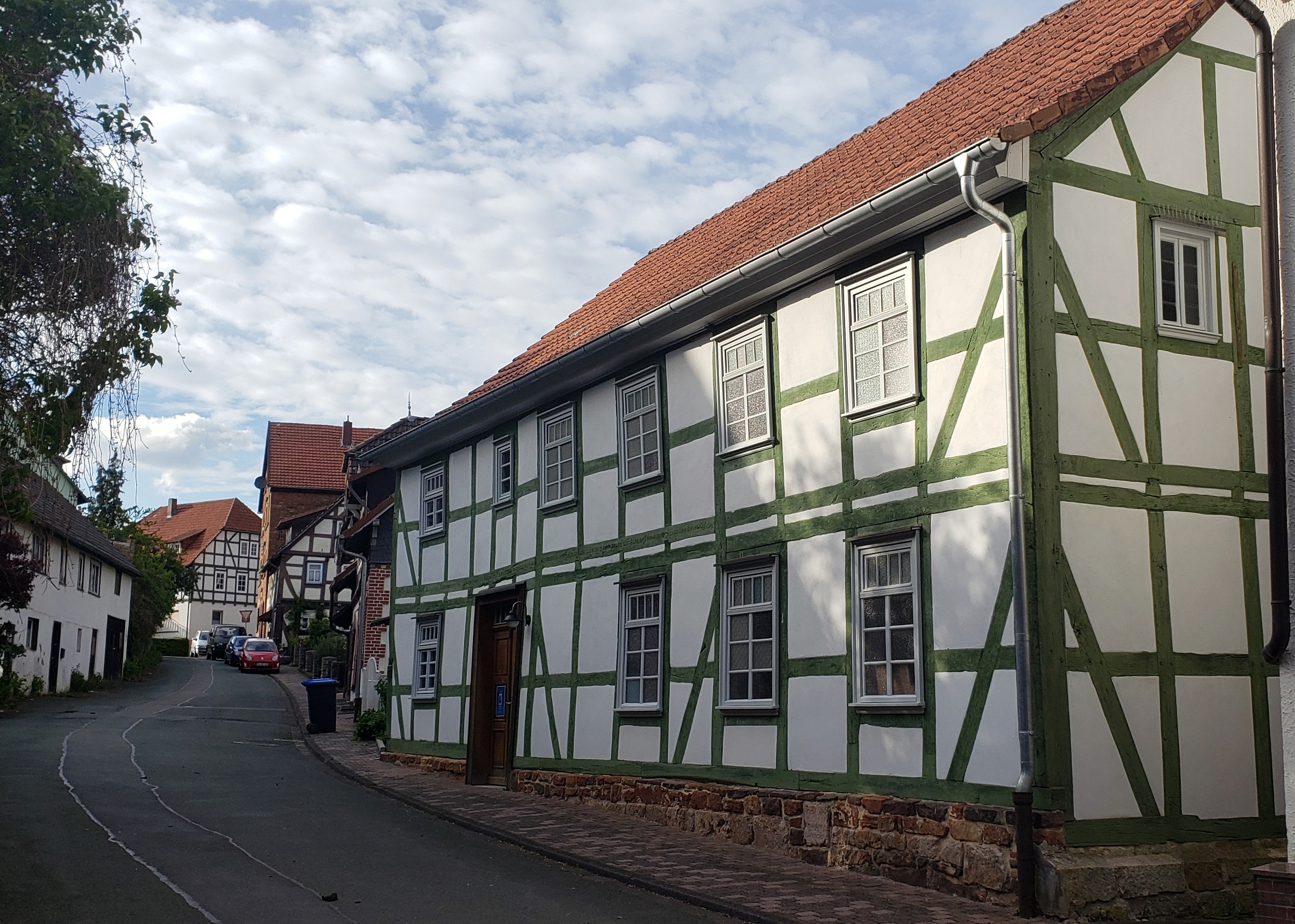
Bertha Rothschild Ballin, 9 November 1823 – 15 January 1882

Ancestry.com, National Archives and Records Administration

Bertha Ballin was the fourth child and first daughter born to Ascher Rothschild and Sprinza Sternberg, and the granddaughter of Salomon Abraham Rothschild. Like the rest of her siblings, she was born in Vöhl, Hesse, Germany.

Bertha was an enigma for quite awhile. We found census records of Jacob James Otto Rothschild living with her and her husband, then living with her after her husband’s death. I assumed he was a border. And then I found a US Passport application for him, and one for her on the next page. The Passport application, dated 10 August 1871, gave me a date of birth, 9 November 1824. It also listed her place of birth as Voehl Prussia. That DEFINITELY caught my attention, and had me questioning their relationship. At this point in my research, I had heard that Ascher and Sprinza had a daughter named Rebecca, to whom he had presumably given 10,000 guilders so she could go off and make her way in the world. Could this be the missing sister? Maybe. I already knew that people in this family can be born with one name and end up with a dozen others. Or could it be another sister? Shortly after finding this, I received an email from Karl-Heinz Stadtler in Vöhl telling me he’d found a record of Bertha Rothschild, daughter of Ascher Rothschild and Sprinza Sternberg, married to Max Ballin in Gießen. Ok. Another sister. Cool!

According to the records from Giessen, she was the wife of Meier Max Ballin, a fabric merchant, and had been accepted as a citizen of Giessen 11 February 1847.  At that time, it indicated that she had been married to Meier at the age of 22, which would have been in 1846.  This corresponds with her birthdate of 1824.

Boston Eagle 7 November 1854

The next mention we have of Bertha’s husband Max is from a news clipping of the Boston Eagle dated 7 November 1854. Apparently Max was involved in a lawsuit where he was accused — and found guilty — of putting fake labels on an inferior product and trying to pass it off as high-quality champagne. I especially like the argument his attorney gives for why he shouldn’t serve time.

Given that both Bertha and James Otto applied for passports on the same day, with the intent of traveling to Germany, I like to think they were going home to visit the family.

The next mention we have of Bertha’s husband, Max, is from a small article in the Boston Eagle, dated 7 November 1854. By this time, Max was a wine merchant, and was involved in a lawsuit where he was charged with putting fake labels on an inferior product and passing them off as high-quality champagne. I love this brief news clipping, especially the reasoning his attorney gives for not sentencing him. So, not the straightest arrow in the quiver, old Max.

The next we hear of Bertha is from a ship’s manifest for the SS Hammonia, which departed Hamburg on 22 February 1862. I’m assuming she was coming back to New York after a visit to family. She traveled first class, listed her age as 36, which puts her birth year at 1826.

Max was born 14 March 1813 in Rotenburg an der Fulda, Hesse, Germany, the son of Nathan Ballin and Betty Wertheim. He declared his intent to become a US Citizen on 29 October 1853, listing his residence as New York and his profession as wine merchant. Max died from Consumption on 29 October. He left a very detailed — and interesting — will. It [1] was filed with the court on 9 November 1869.  In it, he lists Joseph and Samuel Seidenberg as his executors.  He instructed them to invest the sum of $10,000 in whatever manner they saw fit, and that the interest derived was to be given to his wife Bertha.  Additionally, he left her all the furniture, portraits, kitchenware and household goods.  Another $10,000 was to be invested, with the interest to go to his mother, Betty Ballin, living in Frankfurt am Main, Germany.  There were a couple of smaller bequests, but he left the bulk of his estate to be divided equally among his siblings, and/or his nieces and nephews.  Max states that he was 62 at the time he wrote his Will.

The executors, Joseph and Samuel Seidenberg, took their responsibility quite seriously, and I get the feeling they didn’t really like Bertha. On 3 April 1870, they filed a detailed inventory of Max’s estate with the court. To say it was extensive would be an understatement. It listed every article that was in the home from tablecloths to carpets to bedding to furniture. And it was all given a value. A second page lists everyone to whom Max had lent money, with the amount due listed in one of the following three columns: Good, Doubtful, Bad. There were 4 members of the Rothschild family listed:

Isaac Rothschild, New York, $835.96, Doubtful

Justus Rothschild, Wien (Vienna), $39, Good

Jas. O. Rothschild, Hoboken, $330, Doubtful

Ad. Rothschild (no location), $87.86, Doubtful

Justus Rothschild is the son of Bertha’s oldest brother, Siegmund. I believe Ad. Rothschild to be Adolph Rothschild, Bertha’s next youngest brother. That no location is listed for him doesn’t surprise me, as he moved a lot.

On 28 June 1871, Bertha filed a petition with the Chancery Court of New Jersey, contesting her husband’s Will in general, and the accounting practices of the executors in particular. But a ruling dated 21 October 1871 stated the Will would stand, as would the value of the estate as determined by the executors.

The 1880 census shows Bertha living at 127 Garden Street in Hoboken, New Jersey, the same address where she and Max had lived since moving to America. They often had boarders living with them in the large townhouse. While her brother, James Otto, wasn’t living with her in 1880 — at that time he was living with their niece Sophie Rothschild Einstein and her family in St. Louis — she did have Rafael and Lily Palomina of Cuba living with her. Also per the 1880 census, she listed her age as 42. Hey, I get it. We women reach a certain point where we are in denial of how old we really are, and Bertha was no exception.

On 15 January 1882, after 6 days of illness, Bertha passed away from Smallpox, with “disease of the heart” as a contributing factor. She was buried in Hoboken Cemetery in North Bergen, New Jersey. Her death certificate lists her age as 57, which lines up with her 1824 birthdate.

I found the following information about the cemetery at https://en.wikipedia.org/wiki/Hoboken_Cemetery: The Hoboken Cemetery is located at 5700 Tonnelle Avenue in North Bergen, New Jersey, in the New Durham section. It was owned by the City of Hoboken. The Flower Hill Cemetery borders it on two sides. Although one may have the sense of a well-groomed and cared for cemetery when first arriving at Hoboken Cemetery, just a short walk in any direction and you will find a different story. The Secaucus Junction was built on land that was partially the Hudson County Burial Grounds. The exhumed bodies were to be re-interred at the Hoboken Cemetery, but that was canceled when the cemetery was found to have been recycling older full graves that did not have tombstones, and selling them as virgin plots. The cemetery said it has no record of any bodies being buried in those plots.

Ordinarily, if the person and their spouse are both dead, then I call the blog post complete and I move on. But Bertha is a different story. It turns out, she held the key to finding out the names of all of her siblings.

When Camille and I went to Vöhl in 2019, she took pictures of all the legible headstones in the old Jewish cemetery, and created a virtual cemetery at findagrave.com. A few months later, she was contacted by a man named Bill in New Jersey. He’s descended from the Jews of Vöhl, had found his ancestor’s headstone, which he didn’t know existed, and had reached out to Camille. Before long, she looped me in on their emails, and the three of us had some great exchanges. One day, Bill sent us an email, stating he’d done a quick search for Bertha, and had found a notice in the newspaper about her estate, listing a number of different people, namely: Isaac Rothschild, James Otto Rothschild, Adolph Rothschild, Sophie Rothschild Einstein, Justus Rothschild, Selig Rothschild, Friedericke Rothschild and Ernst Wilhelm Eberwein, Adolph Rothschild and Kathinka Luja Rothschild, Moritz Rothschild and Karolina Lieber Rothschild, and Rudolph, Otto, Viktor, and Richard Emmanuel. Camille and I were baffled. We knew all the other names by now, figured Friedericke was the elusive Rebecca. But who was the Emmanuel family? We started digging. And finally found the elusive Rebecka Rothschild, who hadn’t run off to seek her fortune, but who had married Rudolph Emanuel and became the mother of 3 sons.

That newspaper article made me curious, and I reached out the Chancery Court of New Jersey, got a copy of all the court papers related to the newspaper article. Apparently, Bertha left her estate to her siblings and, if they were deceased, to her sibling’s children. She listed spouses names for everyone. It was an absolute treasure trove of information! But remember Joseph and Samuel Seidenberg, the executors of her husband’s estate? Well, somehow they made themselves the trustees of Bertha’s estate and were reluctant to hand things over to the rightful heirs. Her brother James Otto Rothschild was supposed to be the primary executor of her estate. Since the Seidenbergs weren’t cooperating, the family banded together and filed a petition to gain possession of the estate. The battle went on for months before the family finally won. When all was said and done, they divided an estate worth about $3000. After all the court fees, I’m not sure there was much left.

I’m sorry the family had to go through this. But I’m grateful the family went through this, because the 80 plus pages turned out to be a genealogist’s dream! A positive well-spring of information. Here is a list of all the family members who are mentioned:

James Otto Rothschild, brother; Isaac Rothschild, brother; Moses Rothschild, brother, and his wife Caroline Rothschild; Adolphus Rothschild, brother, and his wife Kathinka Rothschild; Sophie Einstein, niece, and her husband William Einstein; Justus Rothschild, nephew, and his wife Julia Rothschild; Richard Emanuel, nephew; Otto Emanuel, nephew; Victor Emanuel, nephew; Rudolph Emanuel, husband of deceased sister Rebecca Emanuel; Friederick Eberwein, sister, and her husband Pastor William Eberwein; Sophie Flatau, niece, and her husband Moritz Flatau; Fannie Hirschhorn, niece, and her husband Isaac Hirschhorn.

And that is the story of Bertha Rothschild Ballin. Bless you, Bertha, for all the information you provided us!

Next up is Jacob James Otto Rothschild. Until then, everyone stay safe!

After careful consideration, I’ve changed her year of birth from 1824 to 1823. Please see the Addendum blog post for the explanation.


[1] Author: New Jersey. Surrogate’s Court (Hudson County); Probate Place: Hudson, New Jersey

Dr. Selig “Sali” Rothschild, 6 December 1822 – 6 November 1875

Selig “Saly” Rothschild was the 3rd child and 3rd son of Ascher Rothschild and his first wife Sprinza Sternberg, and the grandson of Salomon Abraham Rothschild. He was born in Vöhl, like the rest of his siblings, on 6 December 1822.

We know very little of his childhood, only that his mother Sprinza passed away on 5 September 1833, a few months before his 11th birthday. Due to his age, he was likely one of the children placed under the guardianship of his cousin Ruben Rothschild, and Ruben’s wife Helene Sternberg, who was his mother’s sister. He did not stay there long. From 1835 – 1840 he attended the Alte Landesschule in Korbach. Korbach is only about a 15 minute (14 km) away from Vöhl, but in 1835, travel would have been by foot, horse, or wagon, so it stands to reason that he resided in Korbach for the bulk of this time. After 1840, he attended the Gymnasium in Bündigen, where his faith was listed as “Jude”.

Note: within the German education system, a Gymnasium (pronounced with a hard “G”), is a state-maintained secondary school that prepares a student for higher education. (https://www.britannica.com/topic/Gymnasium-German-school)

One of the things I truly appreciate about the information found in the biographies at www.synagoge-voehl.de is the rich detail that has been found about individuals, particularly military records. From my observations, typically a young man became eligible for military service at age 20. The military list of the year 1842 states, “Without occupation; rich.” Rich individuals could usually pay someone else to take their place in military service. And the “Contingent list for the district of Vöhl for Completing the Field Troops of 1843” states, “Rothschild, Selig. Residence: Vöhl. Had not appeared at the muster in 1841. And it has been determined that 1842 was his first march.”

While working on this blog post, I came across this little snippet of information on books.google.com. It’s an excerpt from the book “Großherzoglich-Hessisches Regierungsblatt: auf d. Jahr 1847”, page 185. It states, “Doctorates at the Gr. Landes-Universität Gießen. The doctoral degree in medicine, surgery and obstetrics received: 2) on March 26th (1847) Sali Rothschild from Vöhl.”

“Selig” was a popular name with the Rothschild family, and most of them had the nickname of “Sali” or “Saly”, these being interchangeable. Ruben and Helene, for example, had a son named Selig who became a doctor. Because of that, there are a number of references in the biographies from Vöhl that start with “This or another Selig Rothschild”. Such as the one from 22 October 1852 which states, “He or another Selig Rothschild — there are several — received a housing permit, which allowed him to reside in Darmstadt for 1 year.”

photo from Staadtarchiv Fulda

Selig married Bertha Jacobson on 16 February 1853 in the beautiful and impressive synagogue in Fulda, which is the town where Bertha was born on 29 July 1833 to Jacob Jacobsen and Adelheid Homberger. The couple settled in Vöhl, and their daughters were born there; Sophie on 11 November 1854 and Steffanie (also written as Staffanie, known as Fanny) on 8 June 1856.

Selig’s father, Ascher, passed away 13 January 1859. It is believed he became the guardians of his 3 half-sisters, Auguste, Mathilde, and Adelheid. What is known is that sometime before 1861, Selig and his family, along with his half-sisters, moved to Mainz. In Mainz, his half-sisters soon found husbands and were married. Adelheid was first, marrying Julius Isaac Lenneberg in Mainz on 7 October 1861, and Dr. Sali Rothschild was one of the witnesses, listed his relationship to the bride as half-brother.

On 7 July 1862, Dr. Sali Rothschild attended the birth of his niece, Johanna Magdelena Lenneberg, on 12 May 1863, he attended the birth of his nephew, Alfred Lenneberg, and on 18 February 1866, he attended the birth of his nephew, Paul Wolfgang Lenneberg. It’s interesting to note he did not attend nor announce the birth of his niece, Clara Lenneberg, born 28 October 1864. Nor does he seem to have attended or announced the births of his other nieces and nephews through his sisters Auguste, who married Heinrich Calman, and Mathilde, who married Heinrich Bayerthal. This may be because Auguste and Mathilde converted to Christianity at the time of their respective marriages, though this is purely speculation. To be honest, for years I thought the family as a whole had little to do with those members who had converted, but recently I’ve begun to believe that was not the case at all.

Selig and Bertha’s daughter Sophie (11 November 1854 – 13 December 1922) married Moritz Flatau (3 July 1840 – 9 July 1899) were the parents of Elisabeth Flatau, Carl Stefan Flatau, and Hans Ernst Flatau.

Their daughter Steffanie (8 Jun 1856 – 6 Mar 1891) married Isaak Isidor Hirschhorn (25 March 1851 – 28 March 1925) were the parents of Ernst Sally Hirschhorn.

Dr. Selig “Sali” Rothschild passed away in Mainz on 6 November 1875, just one month shy of his 53rd birthday. One of the informants on his death record is Isfrid Jacobson, his brother-in-law.

Ancestry.com. Mainz, Germany, Births, Marriage and Deaths, 1798-1875

In family history research, one piece of information often leads the researcher in unexpected directions. For example, when my cousin Camille found the death record of Bertha Jacobson Rothschild, and shared it with me, we wondered who the informant was and why Bertha was in Hamburg. The informant was Elisabeth Flatau, a name that was, at that time, unfamiliar to us. It didn’t take much digging to discover Elisabeth was Bertha’s granddaughter. That led us to Elisabeth’s father, paternal grandparents, and siblings. Then another look at Selig’s death record, and recognizing the last name of one of the informants, led to information about Bertha’s parents and siblings. It’s kind of like ripples in a pond. It’s one of the things I love most about genealogical research.

Bertha far outlived her husband, passing away in Hamburg on 4 January 1913.

Ancestry.com. Hamburg, Germany, Deaths, 1874-1950 [database on-line]. Provo, UT, USA: Ancestry.com Operations, Inc., 2015.

Our next post will be about the first daughter born to the Ascher Rothschild family: Bertha. She definitely had an interesting life, and led us to finding so many unexpected family things! Until then, stay safe, and hug those you love and hold dear.

Isaac Rothschild, 23 June 1820 – 26 December 1897

This is the second of two posts about “What’s in a Name” or, more appropriately perhaps, “A Tale of Two Isaacs”. The first post concerns Isaak Rothschild 1799 – 1875. The two men were first cousins, both being grandsons of Salomon Abraham Rothschild. This Issac is the son of Ascher Rothschild and Sprinza Sternberg. A lot of the information concerning Issac comes from the Synagogue Vöhl website. I’ll be sure to share where the other documentation comes from.

Isaac was the second child and second son born to Ascher Rothschild and Sprinza Sternberg. He was born 23 June 1820 in Vöhl. His name is sometimes written “Isaak”, sometimes “Isaac”, and sometimes “Isai”. Because of this, a number of the references to this Isaac were attributed to his cousin Isaak, and vice versa. It took a while to sort it all out.

On 5 September 1833, his mother, Sprinza Sternberg, passed away, likely due to complications in childbirth. Following her passing, the younger children were placed in the care of their father’s nephew, Ruben Rothschild, and Ruben’s wife, Helene Sternberg, who was Sprinza’s sister.

On 14 October 1842, in the Civic records of Vöhl, Isaac Rothschild is listed as “reclaimed citizen; Place of Worship – Vöhl; Occupation: Businessman; NOTE: Failed.” This indicates he’d moved away from Vöhl for awhile and had returned, and that his business, whatever it was, had failed. While it doesn’t indicate whether he worshipped with the Lutherans or the Jews, it was likely the latter. It is in this record that he also provides his date of birth as 23 June 1820.

Isaac married Friedericke Dilsheimer on 21 October 1847 in Offenbach. This information was written in the margin of the birth record for their daughter, Sophie. Friedericke was born 28 Jan 1824 in Aschaffenburg, the youngest child and daughter of Löb Dilsheimer and Geliche Wolf.

Shortly after their marriage, Isaac and Friedericke moved to Frankfurt. They were the parents of three children. Their first daughter, Sophie, was no doubt named for Isaac’s deceased mother Sprinza (aka Sprinz, Spring, Iris, Bertha, and Sophie). She was born 9 July 1848. Sadly, she only lived 7 days, and passed away on 16 July 1848, in Frankfurt. Their second child and only son, Gustave Gottfried Rothschild, was born in Frankfurt 16 May 1849. Their third child, Maria Rothschild, was born 29 May 1851 in Frankfrut.

After this, the trail for Isaac goes cold, and it’s easy to understand how he and the other Isaak were assumed to be the same person. Friedericke and the children also disappeared for awhile, but I finally found them. In 1875, the “Adressbuch von Frankfurt am Main mit Bockenheim, Bomheim”, found at books.google.com, lists: “Rothschild, Friedericke, gb. Dilsheimer, Wwe.” Rothschild, Friedericke, nee Dilsheimer, Widow. This led me to believe Isaac had died sometime before 1875. But then I found the marriage record for daughter Maria, who married Maximilian Sander of Frankfurt on 30 May 1870. Sadly, the marriage was short-lived, as Maximilian passeed away 27 October 1871. It’s interesting to note that Maxilian’s parents were Alexander Sander and Lenchen Dilsheimer. Lenchen and Friedericke were sisters. So, first cousins got married, which is a little close for comfort in my book. But what really caught my attention is the marriage entry states the bride’s father, Isaac Rothschild, is living “in New York in Amerika.” Well, isn’t that interesting. What’s he doing there?

According to his US Naturalization records, Isaac arrived in New York City in September 1856. He appeared before the Court of Common Pleas on 25 April 1877 and declared his intent to become a US Citizen. His request was granted 29 September 1884. I was able to find Isaac Rothschild listed in several City Directories for New York City between 1880 – 1892. He ran a leather goods import/export business. His home address on East 52nd St wasn’t in a very upscale neighborhood, but it was close to the docks and the warehouses, so likely convenient for his work. Isaac’s bid to become a Naturalized Citizen was approved on 29 September 1884. He listed his address as 351 E 52nd Street, the same address as Isaac Rothschild the leather merchant listed in the city directories, confirming this is the same person.
Maria married Emmanuel Mayer on 24 December 1874, in Paris, France. She was yet again listed as the daughter of Isaac Rothschild and Friedericke Dilsheimer. Maria and Emmanuel were the parents of Alice Leonie Mayer (1877 – 1944).

On 15 January 1882, his sister Bertha Rothschild Ballin passed away in Hoboken, New Jersey, which is just across the Hudson River from New York City. When Bertha’s husband, Max Ballin, passed away a few years earlier, his will listed his executors as having control over the estate, and indicated his wife would receive a stipend. Because of that will, the same executors were to disperse Bertha’s estate to her beneficiaries. They did not. And so the beneficiaries, led by her brothers James Otto Rothschild and Isaac Rothschild, both of New York City, filed suit in the New Jersey Surrogates Court of Hudson County. This 80+ page document turned out to be a fantastic piece of information, as Bertha lists all of her living siblings, as well as the children of those siblings who were deceased.

From the France Archives we learn Isaac’s son Gustave married Hélène Clémence Noémie Lévy in Paris on 24 May.  “Marriage contract between Gustave Rothschild, born in Frankfurt (Germany), German subject, commission merchant, rue d’Hauteville n ° 38, son of Isaac Rothschild, also a merchant, residing in New York (USA), and Frédérique Dilsheimer, rue Lafayette n ° 106, and Hélène-Clémence-Noémie Lévy, rue du Faubourg Montmartre n ° 30, daughter of Bernard Lévy and Sarah Davis.  Further information:  Other act following May 24, 1886: filing of the marriage certificate and publication papers. Among the property, the future husband brings in marriage the rights in the partnership between him and Wilhem Dilsheimer, for the operation of a house freight forwarder in Paris, rue d’Hauteville No. 38, under the company name ‘Dilsheimer and Rothschild.’ From this record, we see that Friedericke (aka Frederique) is alive and living in Paris.  The William Dilsheimer listed here is Gustave’s 1st cousin.  He was the son of Friedericke’s brother Joseph Dilsheimer and his wife Rosalie Eskeles. Gustave and Helene were the parents of Henri Leon Rothschild (1887 – ?), and Marthe Sarah Rothschild Wolf (1889 – ?).

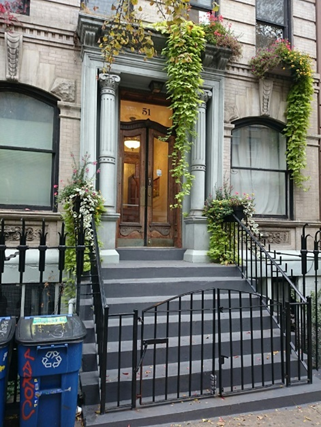
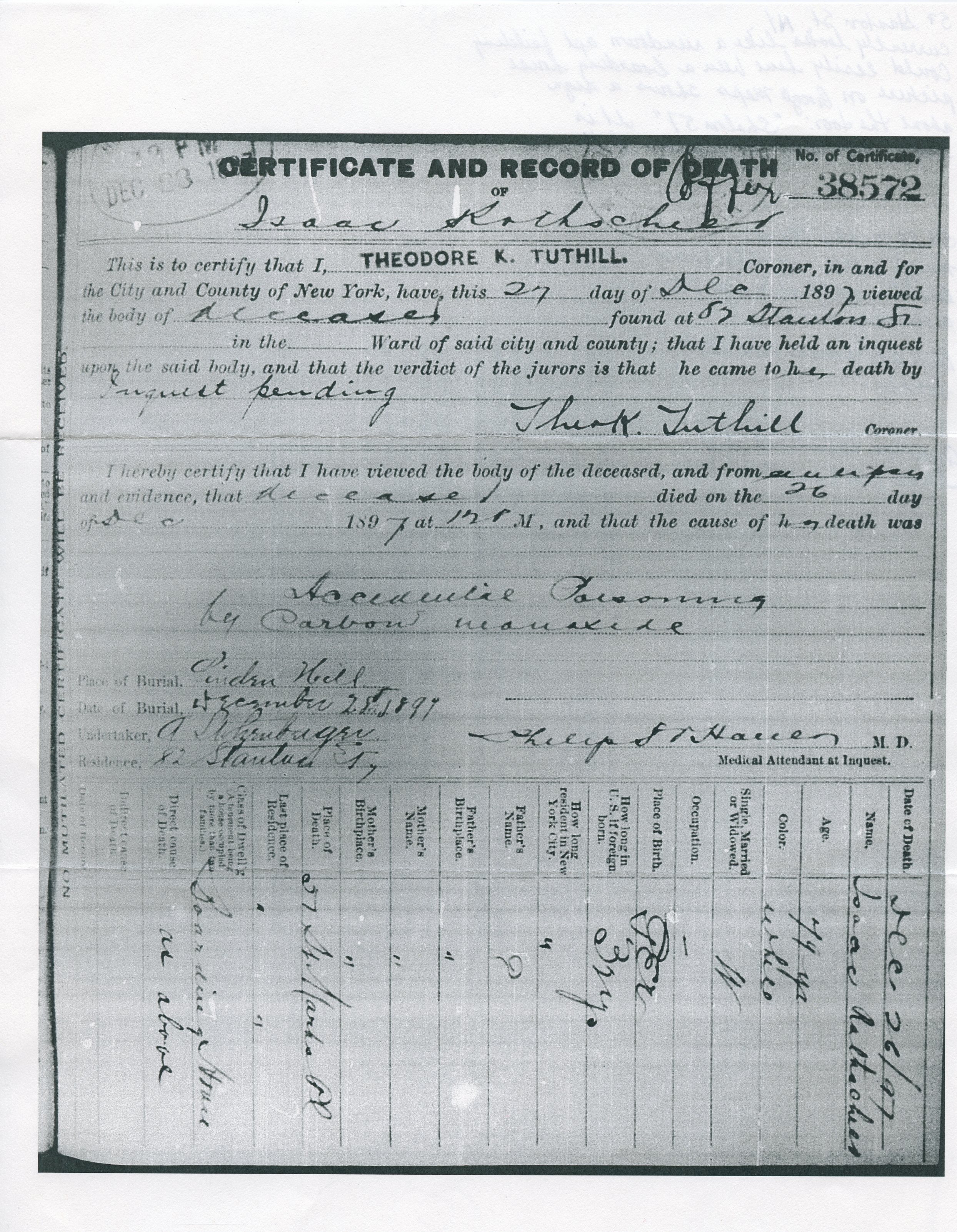
In 1892, Isaac retired from the import/export of leather goods, and turned the business over to his son Gustave. Upon his retirement, he moved to 51 St, Marks Place in New York, a boarding house run by Mrs. Fritsch. It was there, on 26 December 1897, that Isaac passed away. His death made the New York Times, and reads as follows:
ISAAC ROTHSCHILD DEAD.

An Old-Time Leather Merchant Suffocated in His Room by Gas – Familiar East Side Figure.

Isaac Rothschild, seventy-nine years old, of 51 St. Mark’s Place, was found dead in his room yesterday, having been killed by breathing illuminating gas, which had escaped from an unlighted gas stove.  It is believed by his friends that death was the result of accident and not suicide, as reported by the police

Mr. Rothschild had occupied a room on the top floor of the house since he retired from the business of a leather merchant five years ago.  When he retired, he turned over his capital to his son, Gustave, on the condition that the latter would support him during his declining years.  The son opened an establishment in Paris and sent his father a liberal allowance monthly.

About two years ago, Mrs. Helen Fritsch put a gas stove in the old man’s room.  One night, however, through carelessness he left the unlighted burners open and was found unconscious on the floor.  He was with difficulty resuscitated.  That accident happened not long after the stove was placed in his room.  Then the gas stove was replaced by an oil stove, but the old man complained the other day that the oil stove smelled badly and he wished the gas stove back again.  His desire was acceded to, and the gas stove was replaced on Christmas Day, with particular warning that he use it properly.  He said that he understood its use, and would be very careful.

Mr. Rothschild retired to rest about 10 o’clock on Saturday night, after having passed a pleasant hour with others in the house.  At 2 o’clock yesterday afternoon, a servant tried to get into his room, but found the door locked.  She also smelled the odor of gas, and informed Mrs. Fritsch.  Others then went to the room and forced open the door, to find the aged occupant of the apartment lying dead on the floor, with volumes of gas flowing from the burner in the stove, which had been left unlighted.  It was evident that the stopcock had been turned off and on again.  Mr. Rothschild was in his night clothing.  He had apparently gone to bed and had been awakened by the sensation of suffocation.  With an effort, it is supposed, he arose and fell unconscious while attempting to make his way out.

His friends scout the idea of suicide, for they say that he was a man of contented mind.  He was a familiar figure in the neighborhood and a favorite of the children in the entire vicinity.

Mr. Rothschild’s wife died many years ago.  Besides his son, a married daughter lives in Paris.His death certificate indicates he’s buried at Linden Hill Cemetery. My cousin Camille, who lives in New York City, took an outing to Linden Hill Cemetery, and could not find him anywhere. While she was there, she met a kind Samaritan who informed her Linden Hill has two halves: the Jewish half, and the Methodist half. A little bit of metaphorical digging, and she found him, in an unmarked grave in the Methodist half. Without relatives nearby — his closest living relative would have been his younger brother, Adolph, who was living in St. Louis, Missouri at that time — it’s believed that his landlady, Mrs. Fritsch, or some others of his acquaintance, arranged for the burial.
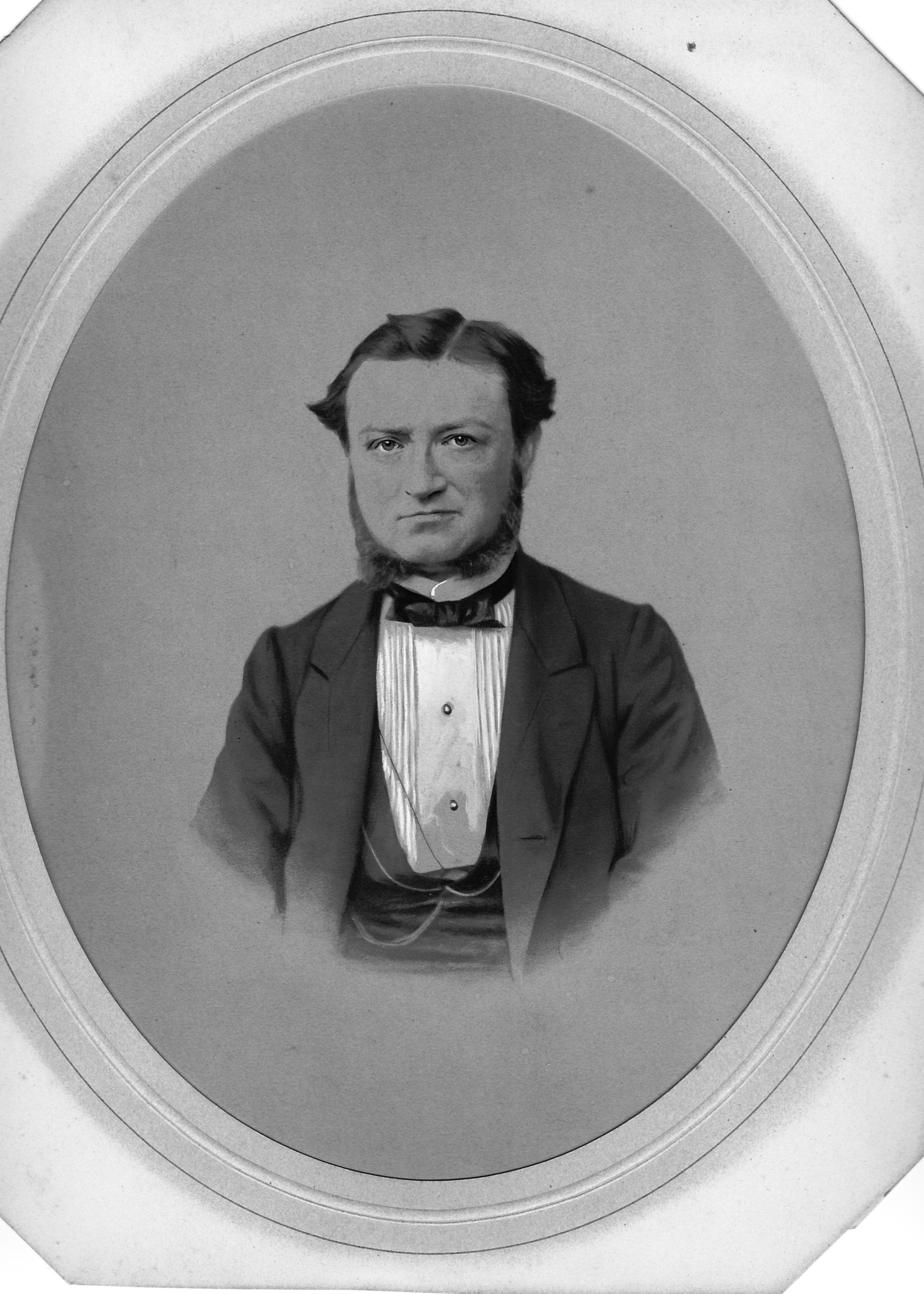
As for Friedericke, like Mark Twain, the rumors of her demise were greatly exaggerated. She lived the remainder of her life in Paris, outliving her husband by nearly 6 years. She died 10 August 1903 in Montmorency, Val-d’Oise, Ile-de-France, France. She is buried in Montparnasse Cemetery in Paris.

Next time we’ll learn about Isaac’s brother, Dr. Selig “Saly” Rothschild. Until then, stay safe.

Siegmund Salomon Rothschild, 17 July 1818 – 7 September 1877

Up until a couple years ago, I believed Siegmund and his wife had one son, and that was it. Then, out of the blue, I was contacted by a new-to-me cousin, Andy Selig, who let me know not only did Siegmund also have a daughter, but provided me with family photos, and information on 5 more generations of descendants! So, huge thanks to Andy for the photos and for more info, some of which we’ll see here, some of which we’ll learn about when I write about his children.

Siegmund was born 17 July 1818 in Vöhl, and was the first child born to Ascher Rothschild and Sprinza Sternberg, and grandson to Salomon Abraham Rothschild. His parents were married in November the previous year, so he was an 8 month baby. The Synagogue Vöhl website has very little available about Siegmund, stating only that he attended the state school in Korbach from 1832 – 1824. I calculated his date of birth by taking the information from his death entry which states he was 59 years, 1 month and 20 days old at the time of his death.

Siegmund’s parents had 9 children, born between 1818 and 1833. Siegmund would have been 15 when his mother, Sprinza, passed away in September of 1833.

The list of military servants of 1838 states Siegmund Rothschild is “Tradesman, wealthy, can handle horses.” In 1841, the Civic Records of Vöhl state “Ascher Rothschild’s children from his first marriage have a guardian.” I doubt this applied to Siegmund, as he’d have been 23 by then.

Siegmund married Betti/Betta Homburger, daughter of Isaak Herz Homberger, on 21 February 1844. The marriage date is found in the book “Juden in Gießen 1788 – 1942” by Hanno Müller. I do not yet have a copy of this book, but was sent a photocopy excerpt by Herr Berg, the vestryman for the Lutheran Church in Burg-Gemünden. Betti was born 10 September 1823 in Gießen. Her date of birth comes from the book “Juden in Gießen 1788 – 1942” by Hanno Müller.

The couple lived in Offenbach am Main, where Siegmund was a resident and a manufacturer, though I don’t know of what. They had two children born to them: Justus Friedrich Rothschild (6 May 1847) and Sophie Rothschild (24 December 1844). The genealogists among you are probably wondering why I listed the children in reverse birth order. That’s because until I was contacted by Andy Selig in late 2018, I didn’t know Sophie existed. And it was because of that information that we began to learn that my gg Grandfather, Adolph Rothschild, wasn’t as isolated from the rest of the family as we’d believed up to that point. But I’m getting ahead of myself. I will, I promise, cover that when I get to Adolph’s biography. And it’s going to take several posts!

It’s clear to see from the photographs that the family was fairly well off. We know that Siegmund came from money — it’s been reported that his father, Asher Rothschild, provided each of his children with 3000 guilders during his lifetime. And Betti and the children are extremely well-dressed. From this second photo, which I suspect was taken around 1857, we can see that Betti has the padded wing hairstyle that was so popular in the mid – late 1850s.

Siegmund passed away at Frankfurter Straße 66 in Offenbach 7 September 1877 at the age of 59. Which isn’t very old at all. By that time, both children had left home: Sophie to settle in St. Louis with her husband, and Justus to be mostly in St. Louis, but also in New York and Vienna. The end result was the same: Betti was alone in Offenbach.
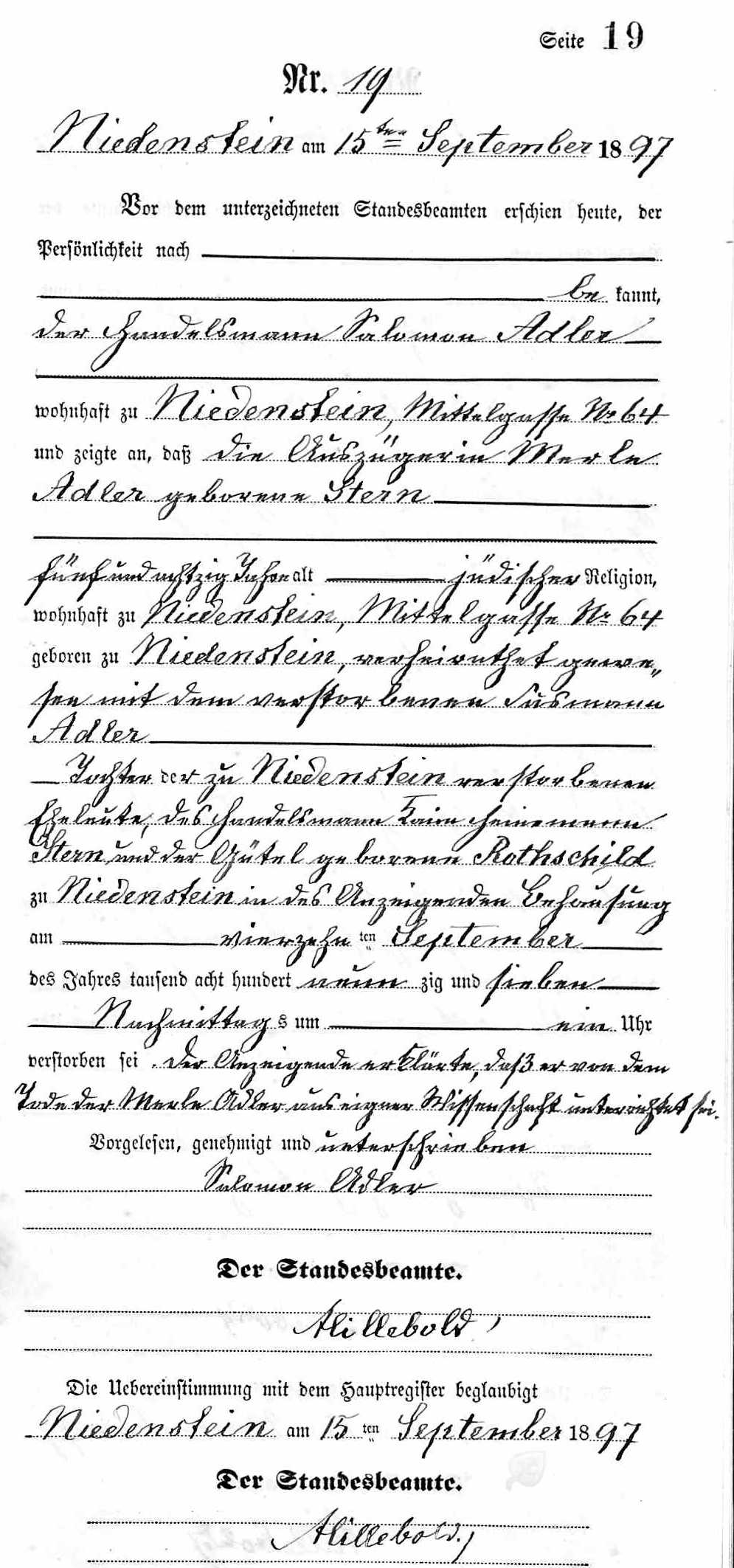
When I first found Siegmund’s death entry, I could read enough German to make out names, dates, locations. In 2019, I was frantically working to put together as much biographical information about the Rothschild family as I could before traveling to Vöhl in May of that year, and even after that I was still working on it, getting everything ready for a family reunion the following July. It was in between those two months that I pulled up Siegmund’s death entry and REALLY looked at it. The first thing I noticed was the informant was “Pfarrar Wilhelm Eberwein”. “Pfarrar” means “pastor”. Why was a pastor signing the death entry of a nice Jewish boy like Siegmund? And that name? Why did that name sound familiar? So I broke out Google Translate, and a website that lists the German words for familial relationships, a pen and paper, and set about the painstaking work of transcribing/translating.

“Pastor Wilhelm Eberwein, a resident of Offenbach, appeared in front of the registrar today, and indicated that his brother-in-law, the pensioner Siegmund Rothschild…” Wait. WHAT??? Brother-in-law?

Well, that had me confused, because Camille and I were pretty certain we’d found most of Ascher and Sprinza’s children at this point. The only one we hadn’t been able to pin down was Rebecca, who had reportedly been given 10,000 guilders with which to leave home and make her way in the world. What if she’d married a pastor instead? More digging, and we found out that Pastor Eberwein’s wife was Friedericke Rothschild, daughter of Ascher and Sprinza. Knowing that everyone in this family — especially the women — has seemingly countless variations on names, we decided she must be the long-lost Rebecca, middle name Friedericke. Well, ok, we found the missing daughter. WHEW! And glad to know the siblings stayed close, despite their differences in religion.

It took me awhile longer to figure out why it sounded familiar. And a little while longer than that to figure out Pastor Eberwein’s real relationship with the family. And we’ll get to that, I promise. But if I tell you now, it’ll spoil the surprise.

Betti Homberger Rothschild passed away in Offenbach am Main 29 January 1902 at Frankfurter Straße 76 in Offenbach, just a few doors down from where she and Siegmund lived together when he passed. According to Google Maps, both houses are still there, but I can’t get a street view. The informant on Betti’s death entry was Jakob Goldschmidt. I don’t know yet who that was.

That’s all the info I have on Siegmund and his wife Betti. I wish I knew what Siegmund manufactured. I wish I knew more about his day-to-day life. But I’m grateful for the bits I do know.

Next time, we’ll learn about Siegmund’s brother, Isaac Rothschild. He was an interesting person. Until then, stay happy and healthy!


Marle Stern Adler, 6 September 1812 – 17 September 1897

Marle Stern is the 5th daughter, and 7th and youngest child of Giedel Rothschild and Kain Heinemann-Stern, and the granddaughter of Salomon Abraham Rothschild. Most of the information for Marle comes from the book by Karl E. Demandt “Bevölkerungs- und Sozialgeschichte der jüdischen Gemeinde Niedenstein 1653 – 1866”. When I finished the previous post, I was looking ahead in the book, and was stunned at the amount of information that’s available for Marle. I don’t mean for Marle’s husband, I mean for Marle herself. So let’s see what we can find out!

As mentioned above, Marle, sometimes written as Merle or Merla or Mehrle, was born 6 September 1812 in Niedenstein. In the Civil register of 1812, she is listed as the daughter of the tradesman Kain Heinemann-Stern of Mittelstraße 46 and his wife Giddel nee Abraham. According to Marle’s death entry, she was the daughter of Kain Heinemann-Stern and Giedel nee Rothschild. Ahh, Giedel; you do make things interesting.

Marle married Süßmann Adler on 15 Nov 1837. Süßmann was also from Niedenstein. He was born 2 April 1810, son of Moses Süßmann and Beile nee Heinemann. Marle and Süßmann were the parents of 9 children. (1) Moses Adler was born 19 September 1838. He married his cousin Sara Stern, daughter of Callmann Stern and Madchen Wertheim. (2) Kallmann was born in 1839. In 1858, he emigrated to America, and in 1911 he was living in Baltimore, Maryland. (3) Betti, born 1841. She married Nathan Speyer in 1872, and died in Fritzlar in 1911. (4) Salomon, born 1843. He married Rechel Hahn, who died in 1885, and he died in 1908. (5) Michel, born 1846. The information for him is pretty interesting. “He comes home from school on 28 April 1860, whereupon his mother is invited to the mayor’s office and encouraged to let him learn a business. They said that since he was still stupid, and also very young, he should stay at home for another six months so that he could learn more and become stronger; then he should take up the profession of carpenter.” Not sure yet if he became a carpenter, but he followed his brother Kallmann to Baltimore, and died there before 1911. (6) Sara, born 1848. She married Simon Goldstein of Felsberg on 24 April 1876. (7) Herrmann, born 1850. Like Michel and Kallmann, he also went to Baltimore. (8) Geldchen, born 8 July 1852. She was known as Karoline, and married Jonas Löwenstein on 13 Aug 1879. (9) Kaim (Heinemann), born about 1855. He also went to Baltimore (I’m wondering if the brothers all went together) and was known as Henry Adler.

In 1830, Süßmann and his brother Kallmann were subject to a council tax of 10 Reichsthaler. In 1835, Süßmann paid in excess off 11 Reichsthaler in citizen’s admission money for a leather fire bucket and 3 grafted fruit trees. In 1837, Süßmann was taxed in the 15th class in the amount of 7 thaler; in 1853/54 he was taxed in the 2nd class of middle-taxed traders, and in the 1st class of butchers, the highest taxed of the business taxpayer.

Süßmann died before 5 June 1855. In 1858, his widow was taxed in the 11th class at the amount of 4 Thalers, and in 1861 in the 13th class at the amount of 5 Reichsthalers. In 1858, with the help of her son Moses, Marle continued the business of her deceased husband: wholesale cattle trade. The footnote, which has the reference of “Aust. mit Randverfüngung StA. Marburg, Best. 180 Fritzlar in Nr. 74”, states the following: Michele submits a corresponding request to District Administrator Weber in Fritzlar in 1858 Oct. 14, whereupon he declares that no special permit is required for the wholesale cattle trade, but warns her not to conduct this cattle trade as an emergency trade and says, “It would also be better if she dedicates her son Moses to a trade rather than raising him for the cattle trade. “ In 1858, Moses would have been 20.

I am in awe of brave, intrepid women, especially those who are widowed young and have small children, as Marle did. As my own mother did.

At the bottom of the entry for Marle and Süßmann, it indicates there are some addendums, which are below.

Addendum 7: 1858 Oct. 14. Request from Merle Adler, widow of the trader Sussmann Ader, for approval of her wholesale cattle trade because she has to support a family of 9 children and has all legal requirements for this trade.

Addendum 8: January 5, 1872. Testament of Merla Adler née Stern, widow of Süßmann Adler. Mehrle Adler née Stern, widow of the merchant Sussmann Adler of Niedenstein, draws up her will and designates all of her children: Moses, Calmann, Betti, Salomon, Michel, Sarchen, Hermann, Julchen and Heinemann as their heirs.
Betti, married to the trader Nathan Speyer II of Züschen, received 700 thalers and a trousseau worth 300 thalers when they married. Since, according to the inventory of June 5, 1855, from her father’s property only 358 Tl. And 2 2/9 Sgr. are entitled, she should receive the additional amount from the testator’s assets.
By taking over the parental real estate and transferring some outstanding debts, Moses has already received his paternal and maternal inheritance.
When they emigrated to North America, Calmann, Michel, Hermann and Heinemann already received a large part of their future fortune, and Sarchen has already been partially compensated for by various donations. All these five children named receive another 300 thaler from the estate. The other two children, Julchen and Salomon, are to share the rest of the property, with Julchen inheriting all the clothes, shirts and all linen from the testator in advance.

The “Julchen” referred to above must be Geldchen.

Marle passed away 14 September 1897 in Niedenstein at the age of 85. She had provided for all her young children, had seen them to adulthood, and had provided generously for them while still living. The death entry was reported and witnessed by her son Solomon Adler.

I hope you’ve enjoyed learning about this family as much as I have, and I hope it helps you in your research. Now that we’re done with the family of Giedel Rothschild and Kain-Heinemann Stern, we’re going to move on to the children of Ascher Rothschild and his two wives: Sprinza and Blümchen Sternberg. There are 12 of them total, and of all the family members I’ve researched so far, I know this group the best, because they were my main focus for a long time. Will I learn new things in the process? I certainly hope so!

Until next time, stay happy, stay healthy, and stay safe.

Calman Heinemann Stern, About 1810 – 11 December 1894

Calman Heinemann Stern, also known as Kallmann Stern, was the 6th child and 2nd son of Giedel Rothschild and Kain Heinemann-Stern, and the grandson of Salomon Abraham Rothschild.

Most of the information we have about Calman comes from the book by Karl E. Demandt entitled “Bevölkerungs- und Sozialgeschichte der jüdischen Gemeinde Niedenstein 1653 – 1866.”

Calman was born in October 1810 in Niedenstein. He married Madchen (Mudchen) Wertheim on 21 August 1843. She was the daughter of Jakob Wertheim and Merle Gumpert. Madchen was born January of 1817 and died 12 July 1881. Her death entry lists her age at time of death as 65, but if she was born in 1817, she’d have been 64.

Calman and Madchen were the parents of five children: Jacob (1844 – ?); Sara (1846 – ?); Isaac (1849 – ?); Kain (1852 – 1878); and Merle (1857 – 1898).

The aforementioned book has this to say about Calman: “Kallmann Stern and his wife Mudchen, née Wertheim, had the above-mentioned 5 children in 1858. He was taxed at 8 thalers in the 16th grade. He was a shoemaker, but had also borrowed on pledges and is supposed to use fabric (yardage) for peddling in neighboring villages, which is why he was warned by the Mayor on July 19, 1858. On February 10, 1859, because of his son Jacob, who was about 14 years old, the mayor asked Kallman to let him (Jacob) learn a business. The father says that his son should go to school until Easter and then learn a business. On June 27, 1859, Kallman was asked to bring Jacob into business within 8 days or to send him to the district office in Fritzlar for a warning. This warning was repeated on July 7th by the mayor, who reported to the county office on October 25th that Jacob was still being kept at home. After further back-and-forth negotiations, the father announced on Feb. 15, 1860 that Jacob was to do his apprenticeship in Grebenstein after Easter, but on May 7, 1860 he was apprenticed to Kaufmann Schloß in Witzenhausen. In 1858, Kallman Stern was elected the community’s calculator (treasurer?) and in 1861, as a shoemaker and capitalist of the 17th grade, taxed at 9 thaler.

I love all the depth and history that comes from various resources, especially civic records. It’s interesting to me that he seemed reluctant to allow his oldest son to be apprenticed anywhere. It’s also interesting to me that the Mayor seemed so intent on having Jacob apprenticed just about anywhere. Wonder what the issue was.

Calman passed away 11 December 1894 in Niedenstein. He outlived both his parents, his wife, one son, and his sisters Beile and Röschen. The witness for his death entry was his son-in-law, Karlmann Plaut, who was married to Calman’s youngest daughter Merle. (Death entry is from the “Persosnenstandsregister Sterberegister; Bestand 920; Laufende Nummer: 5714”, found at Ancestry.com.)

Next up, we’ll learn about the youngest daughter in the family, Marle STERN Adler. Until then, stay happy, and healthy, and safe.

Geldchen Kilchen Stern Kaiser, 1809 – ?

Geldchen Kilchen STERN Kaiser was the daughter of Giedel Rothschild and Kain Heinemann-Stern, and the granddaughter of Salomon Abraham Rothschild.

I would love to tell you that we have as much information for Geldchen as we did for her sister Roschen. But we don’t.

Geldchen was born 7 January 1809 in Niedenstein, Germany. She was the 4th daughter and 5th child born to Giedel and Kain Heinemann-Stern. She married C. Kaiser in Elben, but we don’t know when. According to the book by Karl E. Demandt “Bevölkerungs- und Sozialgezchichte der jüdischen Gemeinde Niedenstein 1653 – 1866”, C. Kaiser was from Elberberg, and that the couple married in Elben.

According to maps.google.com, Elben is 195km to the South West of Niedenstein, while the town of Elbenberg is a short 9.7km due East. I could not find a town with the name Elberberg. While I have the utmost respect for Herr Demandt and all the work that went into this incredible reference book, I’m not convinced his information is 100% accurate in this instance. I’m leaning toward C. Kaiser being from Elbenberg, and that the marriage also took place there.

And that, really, is all we know about Geldchen and her husband. I haven’t been able to find any marriage, birth, or death records for either of them. I would presume they passed in Elbenberg, but without records, can’t know for certain.

Next up, we’ll learn about her brother, Calman Heinemann Stern and his family. Going to get to work on it right away, so you shouldn’t have to wait too long. Until then, stay safe!

Röschen Reisgen Stern Nagel, 1806 – 1877

Röschen Reisgen Stern was the 4th child and 3rd daughter of Kain Heinemann Stern and Giedel Rothschild, and the granddaughter of Salomon Abraham Rothschild. Röschen was born in Niedenstein 8 June 1806. On 14 May 1828, at the age of almost 22, she married Seligmann Nagel.

Seligmann was also from Niedenstein, was born 12 December 1790, the son of Moses Heinemann and Röschen Levi. Together, they were the parents of Sarchen (1829), Dünn/Dina (1831 – 1836), Calmen (1834), Salomon (1836), Selke (1838), Joseph (1841), Abraham (1843), Moses (1846), and Beilchen/Bertha (1849). The following information regarding Seligmann Nagel comes from the book “Bevölkerungs- und Sozialgeschichten der jüdischen Gemeinde Niedenstein 1653 – 1866” by Karl E. Demandt.

Seligmann Nagel is referred to as a dealer as early as 1812. The excerpt from the general protocol of the Fritzlar district office dated June 28, 1827, on the request of Selig Heinemann-Nagel of Niedensten for permission to marry. He can thus prove beforehand that the operation of the cattle and yarn trade has been assigned to him by his father for his own account. On July 16, 1827, Nagel applied for admission to the citizens of Niedenstein, which was granted to him in November against payment of 10 Rt , received. Thereupon Moses Heinemann-Nagel indicates that, in addition to the business, he has assigned his son 12 debt claims in the amount of 2009 Rt. Thereupon the marriage license for Seligmann is given on 6 Dec 1827 by the district office. The marriage announcement at the district office takes place on January 29, 1828 by the father Kain Heinemann-Stern from Niedenstein for his daughter Reischen with Selig Heinemann-Nagel there. He gives his daughter 1500 thalers as a dowry and the usual trousseau. In 1830 Selig Nagel is assessed at 12 Rt. 12 CGr. Corporate and 13 Rt 9 Alb. Municipal tax, and taxed at 14 thalers as a cattle dealer in 1837 in the 20th grade. In 1834 Selig Nagel was the tax assessor of the municipality and in 1843 was appointed second eldest of the municipality. He held this office until 1857 and was meanwhile a member of the district’s class tax audit committee in 1849. In 1853/54 he ranks in the group of traders as well as in the group of butchers in the 1st class of the highly taxed. In 1858 Selig Nagel was 60 years old, his wife Rose, née Stern, 56 years old. The children Selke, 20 years old, Joseph, 17 years old, Abraham, 15 years, Moses, 12 years, and Bertha, 9 years, are still alive. He is taxed in the 24th grade with 25 thalers. He runs cattle wholesale. His son Abraham works with him in trade. At the time of Seligmann’s death in 1859, his inventory showed an asset value of 14,926 Rt. Since Abraham initially does not continue to trade as a wholesaler but as a northern trade, he should learn a business according to the decree of the district office of March 15, 1859. On July 27th it is noted, however, that Selig Nagel drowned, and that her son Abraham continued the business from September 1st, 1859 as a wholesale cattle business. In 1861 Selig Nagel’s widow Röschen nee Stern was assessed as the highest taxed person in Niedenstein with 20 Rt. in the 23rd class of class tax, after she successfully defended herself against an assessment in the 24th class with 25 Rt.

Wow! That’s a lot of information. From it, I believe we can deduce that Selig and Röschen lived quite well. I think it’s interesting to note the wording about the family in 1858: it lists all the children, then says they “are still alive”. Given their ages, the older children could be married and out on their own. I know that their daughter Dünn/Dina passed away at age 4 1/2, but I haven’t been able to find her death record or cause of death. Very, very sad that Selig drowned.

Röschen passed away 19 November 1877 in Gudensberg, near, but not with, her son Salomon. Salomon was the informant on her death record. Her parents names are listed has Kaim Stern and Gidel Rothschild. Despite being written in a TERRIBLE script, it does clearly confirm that she was the widow of Selig Nagel.

Writing this post had me delving deep into the book by Karl Demandt, and helped me learn more about Selig, and that he and Röschen had 9 children, not just 4, which is how many were in my family tree this morning.

Next time we’ll learn about Röschen’s little sister, Geldchen Stern Kaiser. Hoping this finds all of you happy, healthy, and safe.

Abraham Stern, 23 Jan 1805 – ?

Here we have another short bio, this one about Abraham Stern. He was the third child and first son of Kain Heinemann Stern and Geidel Rothschild, and was the grandson of Salomon Abraham Rothschild.

Abraham was born 23 January 1805 in Niedenstein. On 4 April 1841, he married the 23 year old Beilchen Rosenbaum from Grebenstein. As of 1858, there were no known children associated with this couple.

In 1853/1854 Abraham Stern belonged to the 1st class of high taxable trade taxpayers in the group of traders, and was taxed 17 thalers in the 22nd class as a businessman and capitalist in 1858 and 1861. He runs a grocery store. His wife’s application to accept an Israelite foreign maid is rejected by the district administration in 1858.

This is all of the information I have concerning Abraham and Beilchen. I don’t know when they died, or where, though I suspect it was Niedenstein. All of the information comes from the book “Bevölkerungs- und Sozialgescheicte der jüdischen Gemeinde Niedenstein 1653 – 1866” by Karl E. Demandt.

Our next bio will be about Abraham’s sister Röschen. I promise it will have a bit more information than this one. In the meantime, stay happy, healthy, and safe!

Solke Stern Rosenmeyer, 1803 – ?

First of all, I’d like to apologize for the long silence. Despite being toned-down, the holiday season was crazy, hectic, and stressful. Mom had pneumonia, recovered, then both parents had COVID. We saw them a few days before they were symptomatic, so we were on quarantine for awhile. Jim and I had food poisoning New Year’s weekend. Jim’s co-worker tested positive last week, so we’re back on quarantine. I’ve been dealing with chronic migraines on a daily basis… the list seems to be unending. There have been good things, as well. Long conversations with siblings and friends. Launching year two of my Quilt Block of the Month business. Getting started on the first of three commissioned quilts. Spending more time walking my dog, which is good for both of us.

The further I got into January, the further away my ancestors became, until I had effectively forgotten about my blog. Until yesterday, 1/27/2021. Holocaust Remembrance Day. And my cousins started asking me about our relatives who were murdered in the Holocaust. And so today I pick up my virtual pen, and get back to work.

Solke Stern was the second child and second daughter of Kain Heinemann-Stern and Giedel Rothschild, and the granddaughter of Soloman Abraham Rothschild. She was born 1 April 1803 in Niedenstein. Much of the information for Solke (aka Soulke, Soulken, Sulke) comes from the book by Karl E. Demandt entitled “Devölkerungs- und Sozialgeschichte der jüdischen Gemeinde Niedenstein 1653 – 1866”. (I know; the title just rolls off the tongue. But it has been a tremendous resource for me.)

Not much is known about Solke. We know she married Moses Jakob Rosenmeyer (also written as Rosenmeier). He was born around 1800 in Wolfhagen; not sure yet who his parents were. Solke and Moses were the parents of one daughter: Fredchen Friederike Rosenmeyer. Fredchen’s death certificate states her name was Fredchen, but she was known as Friederike.

Fredchen was born about 1832 in Wolfhagen. She married Abraham Jakob Rosenmeyer, who was born in Wolfhagen around 1830. As near as I can tell, they did not have any children. This could be simply because I haven’t found the right records yet.

Death certificate found on ancestry.com. Source Citation: Personenstandsregister Sterberegister; Signatur: 10624

Fredchen died 28 April 1884 in Wolfhagen, at the age of 52. Her death certificate states that both her parents were deceased.

I have no other information about Solke. I do keep running into records for a Moses Jakob Rosenmeyer of Wolfhagen who married Sara Kugelmann, but they appear to be two different people. That they’re related, I have no doubt. Just haven’t been able to make that connection yet.

Despite not being able to learn anything about Solke as a person, I feel a connection to her. Hopefully, someday, I’ll be able to learn more.

Next time, we’ll learn about Solke’s brother, Abraham Stern. In the meantime, stay safe, stay healthy.

Brotmanblog: A Family Journey

Adventures in Genealogy